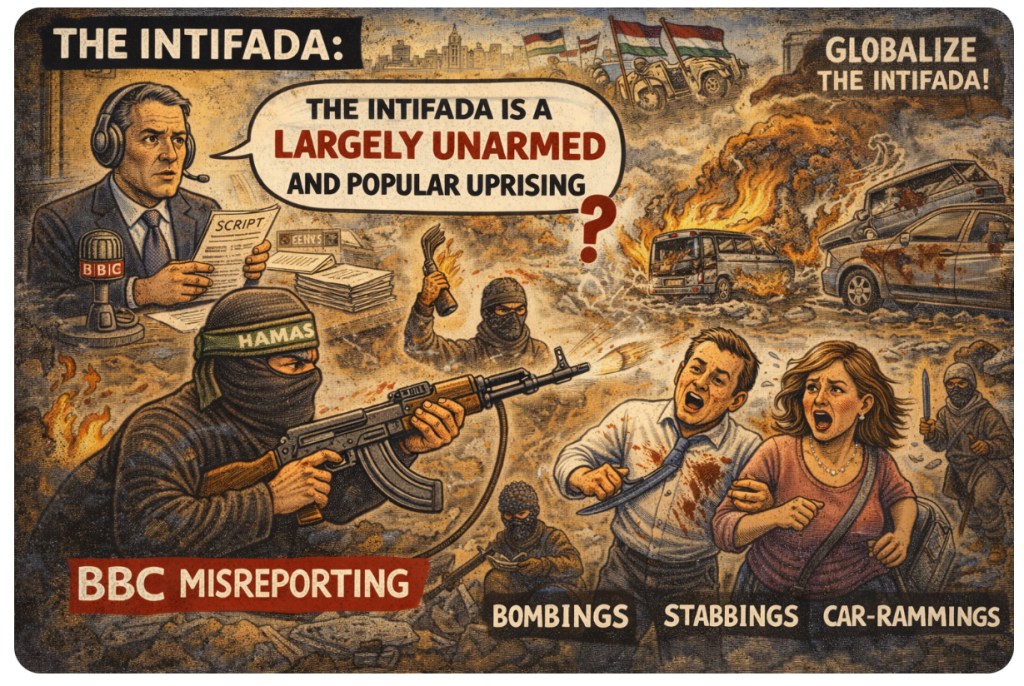
While Israelis were being hunted in the streets last Sunday—real-time terror streamed across global screens—the BBC decided it was time for a vocabulary cleanse. Their latest masterpiece? Referring to the intifadas as “largely unarmed and popular uprisings.”
Popular? Perhaps.
Unarmed? Tell that to the families blown apart on buses, stabbed in cafes, or caught in the wreckage of suicide bombings.
🧠 Rewrite the Narrative, Blur the Blood
This isn’t journalism—it’s PR for terror, brought to you by taxpayer-funded neutrality. The first intifada (1987–1993) wasn’t a song circle. It left 160 Israelis dead, 3,000 injured, and saw Palestinians murdering fellow Palestinians accused of collaborating with Israel.
The second (2000–2005) was a bloodbath: over 1,000 Israelis murdered in brutal attacks ranging from bus bombings to café carnage to school shootings.
But none of that seems to meet the BBC’s new standard for “armed conflict.” Maybe if Hamas handed out manifestos instead of rifles, they’d get a Panorama special.
And let’s not forget the slogan of the moment: “Globalise the Intifada.” It’s being chanted on Western streets while people wave flags soaked in double meanings. Ask any Jew watching those protests what that slogan feels like. It’s not “resistance.” It’s a threat, echoing in every historical scar.
So when the BBC whitewashes terror as a “popular movement,” they’re not just misreporting—they’re gaslighting an entire community. Again.
📛 Challenges 📛
How many lives must be lost before media giants stop romanticising bloodshed? When does “balanced reporting” become dangerous revisionism?
💬 Drop your reactions in the blog comments—no more silent watching while history is rewritten in prime time.
If you’ve had enough of the BBC’s selective blindness, say so. Loudly. Publicly.
👇 Comment, share, tag someone who still thinks the word “intifada” belongs in a neutral sentence.
The rawest truth bombs will be featured in the next issue of the magazine. 📝🔥


 Chameleon Magazine
Leave a comment