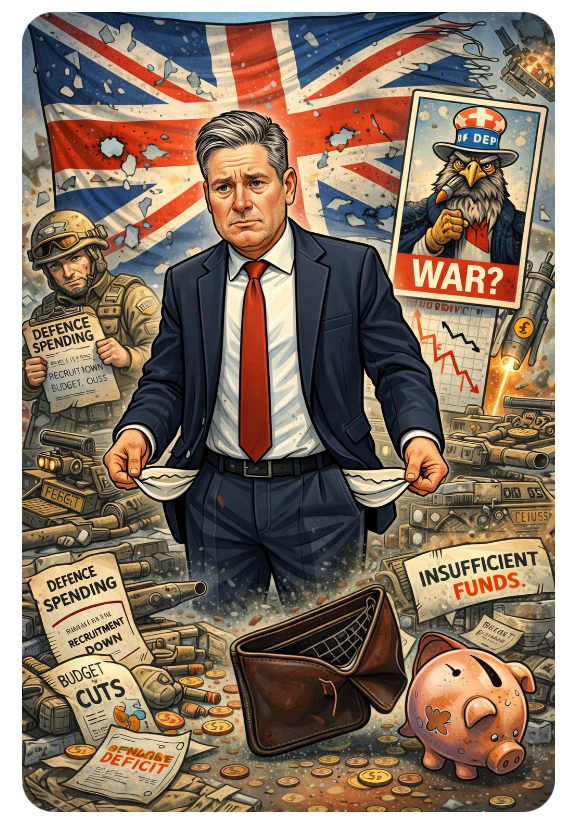
💷🕊️Is Keir Starmer avoiding war because he’s a secret dove? A born-again pacifist moved by the poetry of peace? Or is it simply that the national credit card is already smoking, and the bouncer (aka the bond markets) is watching closely? Let’s be honest: when the country’s finances are held together with fiscal Blu Tack, launching into a shiny new war starts to look less like statesmanship and more like reckless overdraft behaviour.
💣 Can’t Afford a War, Can’t Afford the Pretence
Wars are many things—tragic, destructive, geopolitically complex—but they are never cheap. Tanks don’t run on vibes. Missiles don’t accept “good intentions” as payment. And Britain, already up to its neck in debt, creaking public services, and infrastructure held together by hope and potholes, isn’t exactly in a position to start shopping for conflict like it’s a Black Friday deal.
This isn’t moral restraint—it’s economic gravity. When defence budgets are stretched, recruitment is down, equipment is ageing, and every spending announcement comes with the phrase “fully costed” said through gritted teeth, war becomes less of a policy option and more of a financial prank. Even the most enthusiastic hawk pauses when the spreadsheet screams “absolutely not.” 📉🦅
So no, it’s probably not noble restraint alone. It’s the cold reality that Britain can’t afford bombs and basic services. You can’t preach global muscle when the domestic bones are brittle.
🔥 Challenges 🔥
Here’s the challenge: is peace still peace if it’s enforced by poverty? Or is this just austerity-era realism dressed up as moral leadership? Would the tune change if the coffers were full—or is this the first honest foreign policy we’ve had in years?
Drop your thoughts in the blog comments—not the socials, the actual blog. We want the long takes, the sharp ones, the uncomfortable truths. 💬⚔️
👇 Like it. Share it. Argue with it.
The best comments will be featured in the next issue of the magazine. 📰🔥


 Chameleon Magazine
Leave a comment