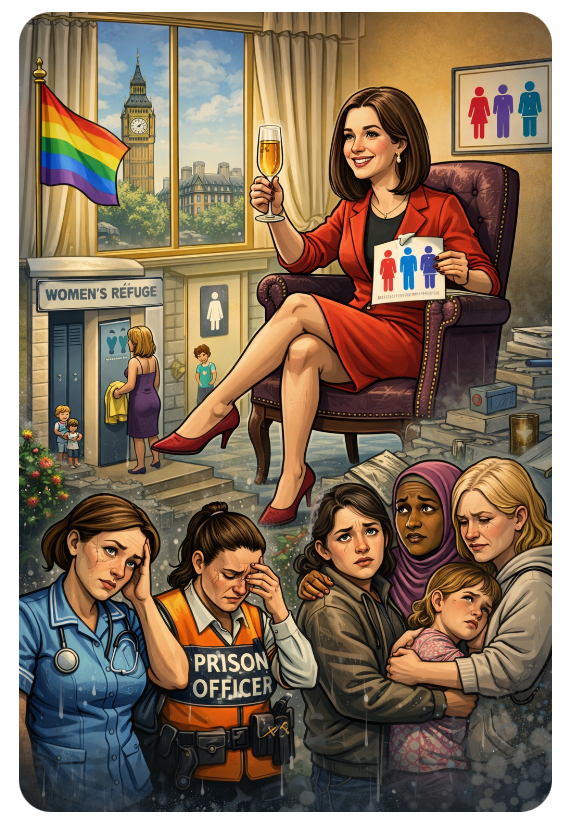
👠⚖️Bridget Phillipson blocking the publication of new trans guidance—guidance intended to clarify and protect women-only spaces—has reignited a question that refuses to go away: why does it so often feel like women in power end up gaslighting other women? Wrapped in parliamentary privilege and press-release language, the decision is defended as progressive, compassionate, and inclusive. But to many women outside Westminster’s thick stone walls, it feels like something else entirely: abandonment with a polite smile.
🏛️ Champagne Feminism and the Safety of Soft Chairs
Let’s be clear—this isn’t about women being “horrible” by nature. It’s about power. Power changes incentives. Inside Parliament, the risks are theoretical, the debates abstract, and the consequences outsourced to women who don’t have security passes, drivers, or private bathrooms.
Calling the guidance “trans-exclusive” plays well in elite political circles, where social capital is earned by being seen as morally pure. But for women dealing with real-world safeguarding—prisons, refuges, hospital wards, changing rooms—this isn’t theory. It’s lived reality.
What’s especially galling is the familiar script:
- Women raise concerns
- They’re told they’re “confused,” “afraid,” or “on the wrong side of history”
- Decisions are made for them, not with them
That’s not solidarity. That’s managerial feminism—where empowerment slogans are plentiful, but dissenting women are quietly pushed out of the room. 🪑🚪
🔥 Challenges 🔥
Here’s the uncomfortable challenge: when did “listening to women” start coming with a hierarchy? When did working-class women, lesbians, carers, nurses, and survivors become acceptable collateral damage for ideological neatness?
If feminism only works for women who already feel safe, is it really feminism—or just branding?
We want your take. Are these decisions about inclusion… or insulation from consequences? Drop your thoughts in the blog comments, not just the socials. Say it properly. 💬🧨
👇 Like it. Share it. Argue with it.
The sharpest, most thoughtful comments will be featured in the next issue of the magazine. 📰✨


 Chameleon Magazine
Leave a comment