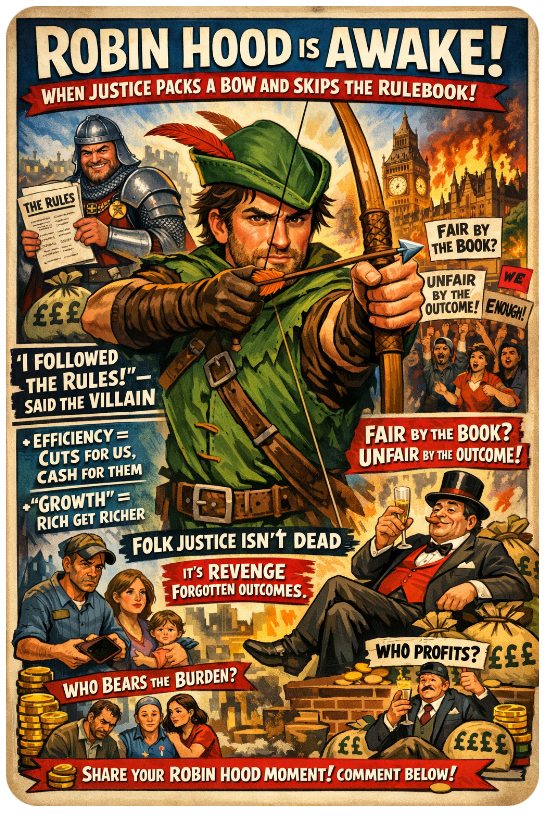
Britain’s oldest political software isn’t coded in laws or policy documents — it’s told in tights. While civil servants drown in fiscal spreadsheets and MPs praise “tough choices” through £200 dinners, the real constitutional backbone of England still hums to a forest-born algorithm: if the rules screw the people, then screw the rules. That isn’t folklore. That’s public infrastructure, baby.
🧾 “I Followed the Rules!” — Said the Villain, Confidently
We’ve been gaslit into thinking fairness lives in spreadsheets and acronyms. “The rules were followed,” they say, as if that’s a full stop and not a siren. But when the outcome is a colder house, an emptier fridge, and a more exhausted carer — it doesn’t matter how tidy the process was. Fairness isn’t a procedural checkbox. It’s a lived reality. And the people living it? They’re starting to call bullsh*t.
Robin Hood isn’t quaint. He’s QA for moral legitimacy.
Modern governance treats fairness like a flowchart. But the British public still sees it as a ledger of outcomes. The government says, “we did it by the book.” The people respond, “you wrote the wrong damn book.”
And that Sheriff of Nottingham? Still alive, now fluent in bureaucratese. He’s competent. He’s compliant. He’s the villain because he does it all by the book — a book that writes off human dignity.
🤺 When Words Like “Efficiency” Start to Sound Like Threats
Ask any working person what “fiscal responsibility” means, and you won’t get a TED Talk. You’ll get a shrug and: why am I broke despite doing everything right? Translate government jargon and the subtext is brutal:
- “Efficiency” = Do more with less, unless you’re wealthy.
- “Targeted support” = Everyone else, brace for impact.
- “Growth” = Bigger yachts, smaller paychecks.
Robin Hood hears it too. Then he aims.
The old story doesn’t need a reboot. It’s running in the background of every protest vote, every angry tweet, every slammed ballot box. It’s not calling for anarchy — it’s calling for arithmetic. If power takes more than it gives, the moral bill comes due.
🧠 Folk Justice Is Not Dead — It’s Just Better at Pattern Recognition
The real red flag? People aren’t apathetic — they’re morally fluent. They’ve learned that when official justice serves only the powerful, justice finds unofficial paths. That’s not chaos. That’s equilibrium.
We didn’t outgrow Robin Hood. We need Robin Hood — not as cosplay, but as a system reboot when the mainframe is corrupt.
The myth endures because it’s not just fantasy — it’s forensic. It strips away jargon and complexity until you’re left with the single most important audit question in public life: Who benefits, and who bears the burden?
🔥 Challenges 🔥
What happens when law feels like a trick, and fairness goes underground? What happens when citizens are told to trust “the system,” but the system only trusts wealth? That’s not rebellion — that’s the reboot button getting warm. 🧨
🗯️ What’s your Robin Hood moment? When did the rules stop feeling fair to you? Jump into the blog comments and share it. This isn’t nostalgia — this is diagnosis.
👇 Comment, like, and share — because if the story’s back, the sheriffs better start sweating.
The best takes will be featured in our next print issue. 📰💥


 Chameleon Magazine
Leave a comment