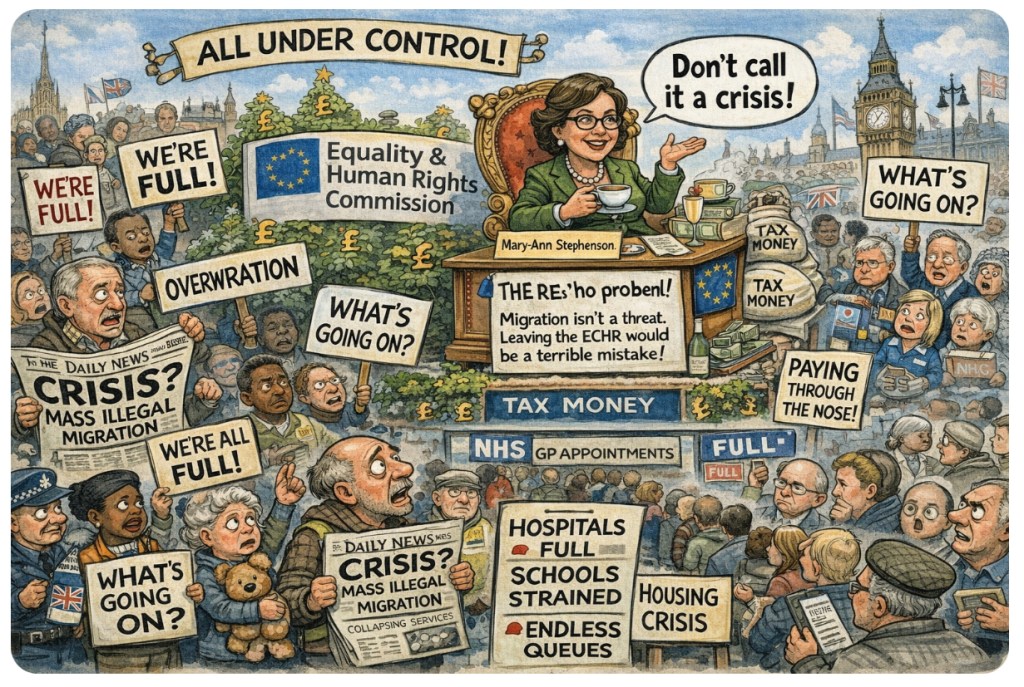
🚨🇬🇧Britain has once again been reassured that everything is absolutely fine—by people who will never have to deal with the consequences.
The head of the Equality and Human Rights Commission, Mary-Ann Stephenson, has warned the public not to describe migration as a “threat to Britain,” cautioning against the “demonisation” of immigrants and suggesting that leaving the European Convention on Human Rights would be a grave mistake.
🧠 Elite Calm, Public Chaos
Once again, a well-paid voice from the institutional bubble has popped up to explain that the public is overreacting. There’s no crisis. No strain. No pressure. No problem at all—just a misunderstanding by millions of people who can apparently no longer trust their own eyes.
Housing lists stretching into the horizon? Imaginary.
GP appointments harder to book than Glastonbury tickets? Coincidence.
Local services buckling under pressure? A myth, obviously.
And the idea that government finances are stretched to breaking point? Please—just another “conspiracy theory,” best dismissed with a wave of the hand from someone whose salary is safely insulated from reality. 💼☕
The frustration isn’t about immigrants themselves—it’s about scale, speed, and the total refusal to admit that systems have limits. The public isn’t demonising anyone; they’re asking why concerns about infrastructure, cohesion, and affordability are treated as moral failings rather than practical questions.
🧾 Labels Instead of Answers
Instead of engaging with those questions, we get lectures. Raise concerns and you’re accused of hysteria. Point out visible change and you’re told you’re imagining it. Ask whether the country can sustainably cope, and you’re informed that the real problem is your tone.
This is the disconnect. Not racism. Not fear. Not hatred. A chasm between those who make policy statements and those who live with policy outcomes.
Nobody is demanding hostility. They’re demanding honesty.
And telling people they’re not allowed to describe what they experience—while being reassured by officials who never queue for the same services—might just be the fastest way to make trust collapse entirely. 📉
🔥 Challenges 🔥
When did acknowledging strain become “demonisation”? Why are ordinary concerns treated as moral crimes instead of democratic input? And how long can institutions keep insisting there’s no problem before the public stops listening altogether? Drop your thoughts—measured, furious, or somewhere in between—in the blog comments. 💬🔥
👇 Comment. Like. Share. Say what polite panels won’t.
The sharpest, most thoughtful responses will be featured in the next issue of the magazine. 🧨📝


 Chameleon Magazine
Leave a comment