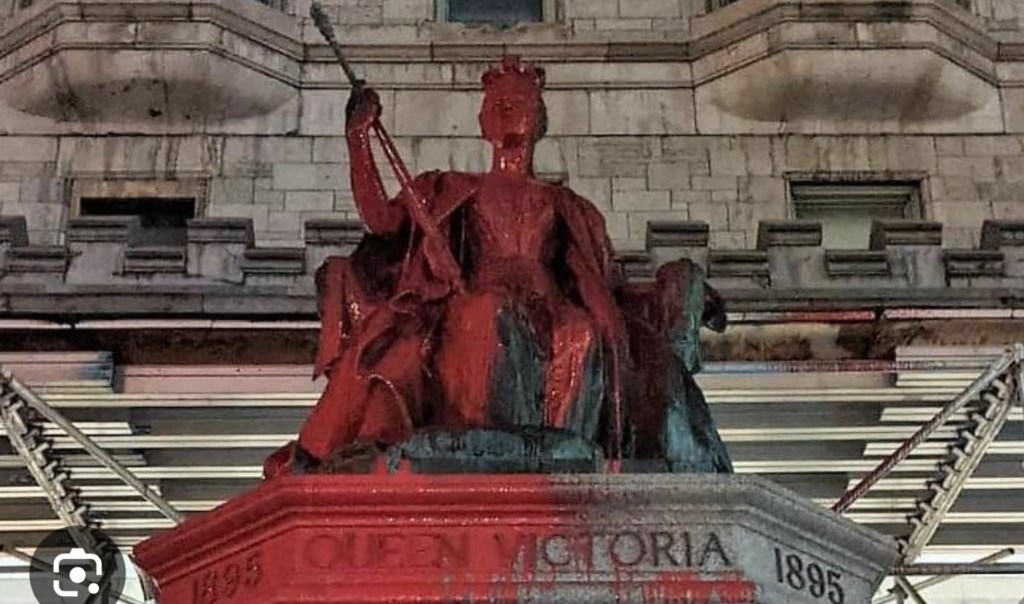
🗿🙈Another statue, another act of vandalism, another round of mental gymnastics to avoid saying what’s plainly in front of us.
A Queen Victoria statue is defaced. Graffiti appears. Slogans are scrawled. And almost immediately, a commentator steps forward to say they’re “not so sure” it was pro-Palestine supporters. Not because there’s evidence it wasn’t — but because certainty would be… inconvenient.
🧠 The Curious Case of Selective Doubt
No, protesters don’t politely sign their work with a calling card. They don’t leave a forwarding address or a stamped confession. But when a statue is spray-painted with slogans like “Free the hunger strike criminals”, most people would reasonably conclude it didn’t happen by accident, a strong gust of wind, or an abstract expressionist with no political interests.
In almost any other context, that would count as circumstantial evidence. Not definitive proof — but certainly enough to form a working assumption while investigations continue.
Yet here, suddenly, the bar for “reasonable inference” is raised to Olympic height.
👮 Evidence? Sorry, Do You Have a Tweet?
We’re told inference isn’t enough. Context isn’t enough. Pattern isn’t enough. Apparently, unless the vandals:
- Live-streamed it
- Tagged themselves
- Issued a press release
- Or posted a slightly offensive tweet
…then it’s all just speculation.
Which is ironic, because we’ve seen police respond faster and more decisively to online speech than to physical criminal damage in the real world. Maybe next time the statue should simply tweet its distress — that seems to get attention these days. 📱🚔
🗣️ Accountability Is Not a Hate Crime
Pointing out that a slogan aligns clearly with a specific political movement is not demonisation. It’s observation. Denying that obvious associations exist doesn’t make society more tolerant — it just makes public debate dishonest.
If a cause is just, it shouldn’t need plausible deniability every time someone acts badly in its name. And if vandalism is wrong — which it is — then it’s wrong regardless of whose politics are involved.
Shrugging and saying “we can’t be sure” every single time sends one clear message: some damage counts, some doesn’t, and some people will always be given the benefit of the doubt that others never receive.
🔥 Challenges 🔥
Why is inference acceptable in some cases but forbidden in others? When does context stop being “evidence”? And why does acknowledging the obvious now require a legal standard higher than a criminal court? Say what you think — clearly, calmly, and without pretending not to see what’s written on the wall — in the blog comments. 💬🔥
👇 Comment. Like. Share. Call out double standards.
The sharpest responses will be featured in the next issue of the magazine. 🧨📝


 Chameleon Magazine
Leave a comment