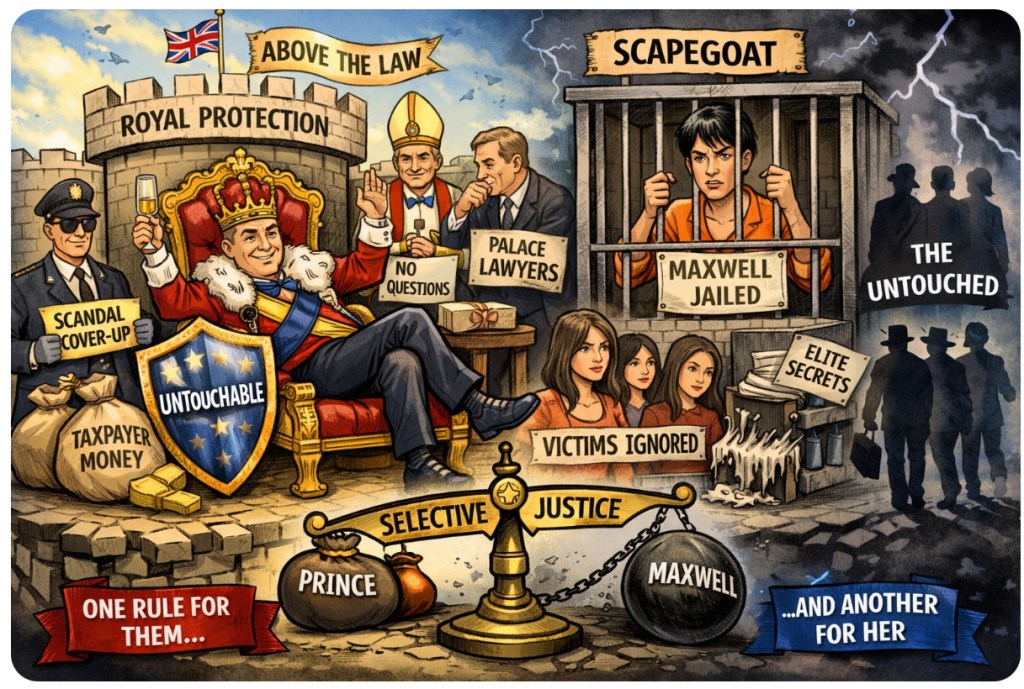
👑🕵️♂️As Prince Andrew’s statements unravel under the weight of new evidence, the real scandal isn’t just personal deception—it’s institutional design. Britain’s monarchy doesn’t just enable privilege; it warps justice in plain sight.
🧼 Royalty, Rot, and the Art of Publicly Surviving Anything
Let’s be clear from the start: this isn’t about one prince fumbling his way through a pizza alibi. It’s about how a taxpayer-funded institution with palatial immunity has successfully built a firewall of deference, silence, and centuries-old illusion around itself—one that makes public accountability optional and scandal survivable.
Prince Andrew, freshly re-embroiled thanks to damning new emails and corroborated accounts, doesn’t just look dishonest—he looks institutionally bulletproof. A man facing serious public allegations lied. Emails say so. Documents confirm it. And yet, somehow, nobody lost their job. Nobody was dragged through court. Nobody even missed their next taxpayer-funded lunch.
Meanwhile, the justice system has served up exactly one high-profile head on a diamond-studded platter: Ghislaine Maxwell. The woman is monstrous, yes—but she’s also become the world’s most expensive scapegoat. A convenient containment vessel for a sprawling network of complicity.
What about the men she operated with, the elites she lunched with, the royals she mingled beside? Are we seriously pretending they didn’t know? Or worse—that knowing wasn’t a problem?
Because here’s the crux: Ghislaine wasn’t a rogue agent. She was a fixture in an elite ecosystem that nourished her. The same system that now insists, with a straight face, that it can’t quite locate the rest of the iceberg beneath her prosecution.
So let’s stop pretending the issue is moral lapse. The issue is structural insulation. Prince Andrew didn’t just lie and survive. He lied and was allowed to. The institution didn’t collapse under the weight of his scandal—it stood still. Unshaken. Unapologetic. And, most damningly, unchanged.
This is what happens when public figures sit in a space above the law, buffered by ancient titles, PR spin, and an army of chinless courtiers whose main job seems to be making sure no one ever faces the consequences of being royal.
Justice has not been blind here. It’s been given a monocle, a CBE, and an off-the-record press briefing.
⚖️ The System Protects Its Own, and Always Has
Let’s revisit a simple question: Why is only one person in jail for a multi-decade trafficking operation that serviced the elite? Is it because she’s the only one guilty? Or is it because she’s the only one without a crown, a knighthood, or a royal warrant?
The Royal Family has, for centuries, demanded reverence in exchange for nothing but ancestry. But when that ancestry becomes a legal shield—and not just a ceremonial oddity—we’ve crossed from pageantry into peril.
And don’t get distracted by calls for “respect for tradition.” This isn’t about bunting and tea towels. It’s about a system that allows one man to escape accountability because he was born with the right blood, the right accent, and the right family crest embroidered onto his silence.
No, this is not about “abolition by sentiment.” It’s about legitimacy by standards. Because if justice can be bypassed with a title, then the monarchy isn’t a symbol of unity—it’s a symbol of exclusion. Not a national treasure, but a national loophole.
And in the face of that, the public must ask:
Do we still consent to a system that creates one rule for princes, and another for everyone else?
🧨 Challenges 🧨
Are we really okay with letting power rewrite justice in real time? Will Prince Andrew be the last to get the royal pass, or just the latest? Let’s not whisper about reform. Let’s demand to know why this institution still exists with no public mechanism of accountability.
Sound off in the blog comments—not just on Facebook. Let’s hear your outrage, your analysis, your fire. 🔥💬
👇 Drop your comment. Drop the mic. Dropkick the myth of royal infallibility.
The sharpest takes will be featured in the next issue of the magazine. 🧠📣


 Chameleon Magazine
Leave a comment