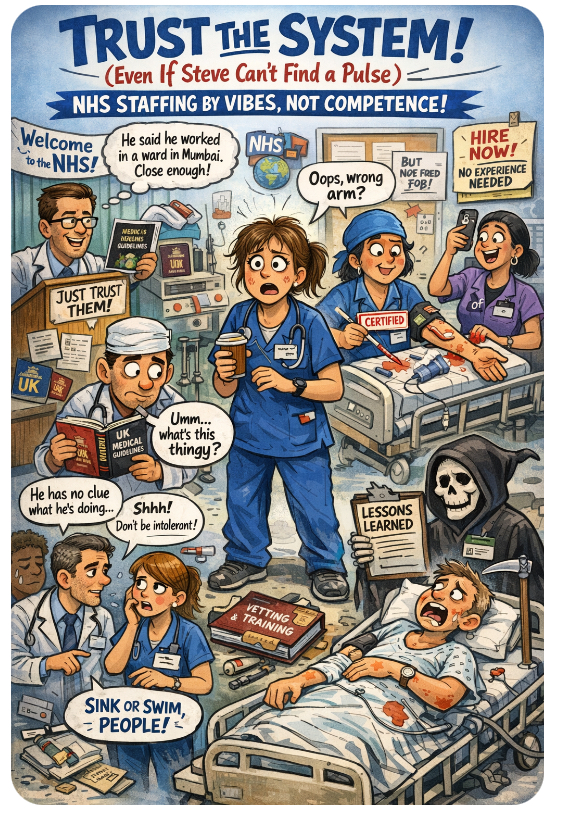
Forget merit. Forget training. Welcome to the modern NHS hiring strategy: stick someone hopeless in the role, then cross your fingers and hope their coworkers will magically compensate for their complete lack of skill. It’s not so much “healthcare” anymore—it’s high-stakes improv theatre with real consequences.
🧪 Sink or Swim… in a Room Full of Drowning Colleagues
Here’s the plan: Chuck someone into a vital role they’re not remotely ready for, pray that Sharon (who’s already triple-booked and running on vending machine coffee) will train them on the fly, and then act shocked when a critical mistake happens. The patient dies, the ward panics, and Management schedules a PowerPoint called “Lessons Learned.”
Oh, and when it all goes sideways? Don’t look at the hiring board, the underfunded training pipeline, or the five warning reports. Just blame the nearest junior nurse, fire them, and repeat. Accountability achieved.
From the wards to the back offices, it’s the same magic trick: slap a badge on someone underqualified, overpromise their capabilities, and hope the entire system will just “absorb” their incompetence. And when the support network collapses from exhaustion or finally dares to speak up? They’re “not being team players.” 🚩
All this because actual investment in competent, well-trained staff might cost more than… say… a minister’s lunch tab.
🌍 The Diversity Mirage: Migrants or Mismanagement?
We’re constantly told that migrants are the backbone of the NHS—and many are. Thousands come here with genuine skill, experience, and the ability to hold entire departments together while the rest of the system buckles. But let’s stop pretending that every single CV handed in deserves blind faith.
Because here’s the uncomfortable truth: just because someone says they worked “on a ward in Mumbai” or “ran clinics in Lagos” doesn’t mean they’re automatically qualified to work in a UK trauma centre. That’s not racism. That’s basic safeguarding.
You wouldn’t hand someone a scalpel just because they said they were a surgeon. You test them. You assess them. You make sure they know what they’re doing before they’re responsible for a human life.
It’s not about where someone’s from—it’s about what they can actually do. But thanks to a mix of desperation, ticking diversity boxes, and terminal HR cowardice, we’ve replaced rigorous vetting with hopeful guesswork.
🤯 When a Warm Body Counts More Than a Working Brain
Let’s not pretend this is about inclusion or opportunity. This is about desperation, optics, and a fantasy that morale can be restored by dragging the competent down to cover the clueless. It’s group trauma disguised as teamwork.
In what other sector would you expect high-stakes professionals to carry the weight of colleagues who literally can’t do the job? You don’t see pilots being told, “Don’t worry if your co-pilot hasn’t trained—just help them wing it at 30,000 feet.”
But here in NHS land, that’s not only tolerated—it’s policy. 🏥🤷♂️
🔥 Challenges 🔥
Why are we handing out clinical authority based on unverifiable claims and blind optimism? Why are whistleblowers labelled “difficult” for wanting colleagues who know how to read a crash cart? Sound off in the blog comments. Tell us what you’ve seen, what’s broken, and what it’s costing real people.
👇 Drop a comment, drop the mic, or drop a truth bomb—whatever you’ve got. The best takes make it into the next issue. 💣🩻


 Chameleon Magazine
Leave a comment