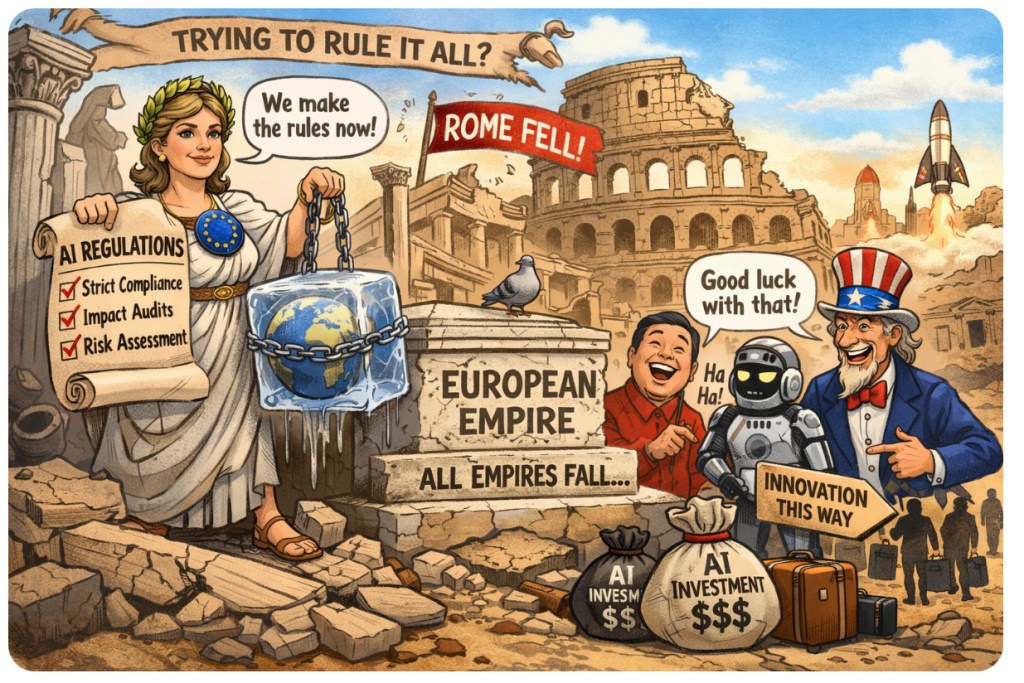
⚠️🧠You froze Russia’s assets. Now you want to freeze innovation? Good luck with that.
Hey Europe, we see the play. First you tried to control the cash—parking Russia’s assets in a geopolitical deep freezer and calling it justice. Now, with AI, you want to do it again: freeze the rules, freeze the power, freeze the world into your vision of “responsible progress.”
But here’s the part you’re forgetting:
You don’t get to rule the future just because you wrote a checklist.
🧊 From Bank Vaults to Neural Nets: The New Imperial Ambition
Europe’s been trying to pull off a two-for-one special lately:
- Tie up adversaries’ money with legal silk—check.
- Tie up the world’s AI with regulatory spaghetti—working on it.
But here’s a small historical reminder:
Control without credibility doesn’t last.
You can build the finest compliance palace in Brussels, but if people stop believing your system benefits them, they’ll walk. Fast.
They’ll walk toward faster innovation, looser rules, and a future that isn’t trying to smother progress in “impact assessments.”
Remember: the power to write the rules only works if everyone agrees to read them.
🏛️ Europe, Meet Your Reflection in Roman Marble
You may want to build an empire of standards.
You may even believe it’s for the good of humanity.
But Rome fell. And not because it lacked laws, but because it forgot that systems only survive when people believe in them.
If you try to rule everything—from the money to the machines—you might just wake up and find yourself ruling nothing.
No trust. No innovation. No seat at the real AI table.
And no one’s signing up for your “digital sovereignty” if it means handing over agility, creativity, and autonomy in exchange for… what?
A lifetime subscription to Risk Classification Monthly?
🚨 Challenges 🚨
Europe’s trying to be the conscience of the world—but is it forgetting how the world actually works? Are we watching a masterclass in moral leadership—or a slow-motion collapse into irrelevance?
💬 Drop your thoughts in the blog comments.
The empire strikes out? Or a reset before rebirth?
👇 Comment, debate, share like you’re sending smoke signals from the ruins of the Senate.
🗣️ The best replies will echo in our next magazine issue—louder than a Roman horn at dawn.


 Chameleon Magazine
Leave a comment