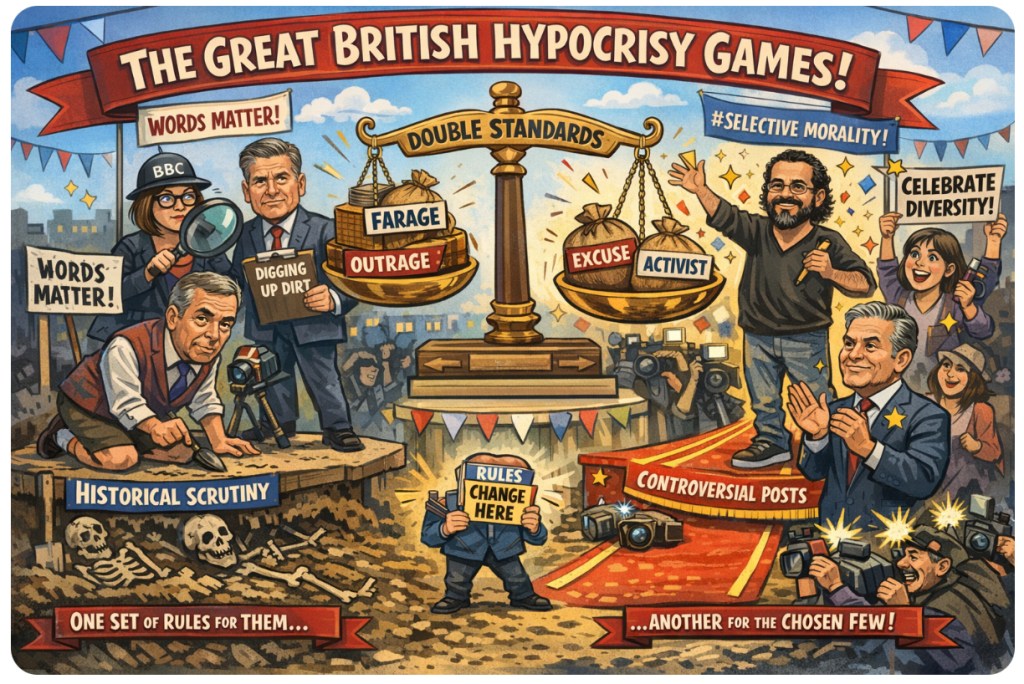
When double standards become government policy, public trust doesn’t erode—it combusts. Welcome to modern Britain, where schoolboy insults are scandalous, but inflammatory activism gets the red-carpet treatment (with hashtags).
🎭 Welcome to the Great British Hypocrisy Games
On today’s episode of “Selectively Outraged Britain,” we find ourselves in a moral obstacle course designed by the Starmer government—where teenage playground jibes from forty years ago are treated like war crimes, while inflammatory political rhetoric from last week gets brushed aside with a shrug and a press release.
Apparently, context is dead. Unless you’re the right kind of activist.
Nigel Farage, that human lightning rod, has had his adolescent idiocy dissected like it was found on a stone tablet at an archaeological dig titled “The Evil Origins of Right-Wing Men.” Meanwhile, Alaa Abd el-Fattah—celebrated Egyptian activist and alleged online flamethrower—gets the full standing ovation from the same crowd that told us “words matter” with the urgency of a fire alarm.
So what gives? Simple: we’re not watching justice, we’re watching messaging. And the message is: morals are now menu items, to be served hot or cold depending on the political appetite.
Words are apparently eternal and radioactive… unless they’re inconvenient to the narrative. In which case, “that’s not the point,” “you’re missing the context,” or—my personal favourite—“this is about something bigger.”
Right. Bigger than intellectual consistency, apparently.
Because nothing screams “integrity” like rebranding past extremism as a footnote, while scouring your political enemies’ childhood diaries for cancel-worthy content. 🕵️♂️📓
🔥 Challenges 🔥
Why are we tolerating a government that swaps moral codes like phone cases? Why do some get full forensic audits on playground name-calling, while others get a PR firm and a standing ovation? 🧐📺 Tap into your outrage, your irony, or your best satire—we want it on the blog. 💬🔥
👇 Light up the comments, slap that like, and share this with someone who’s still clinging to the illusion of fair play.
The best takes will be featured in the next issue of the magazine. 🎯📝


 Chameleon Magazine
Leave a comment