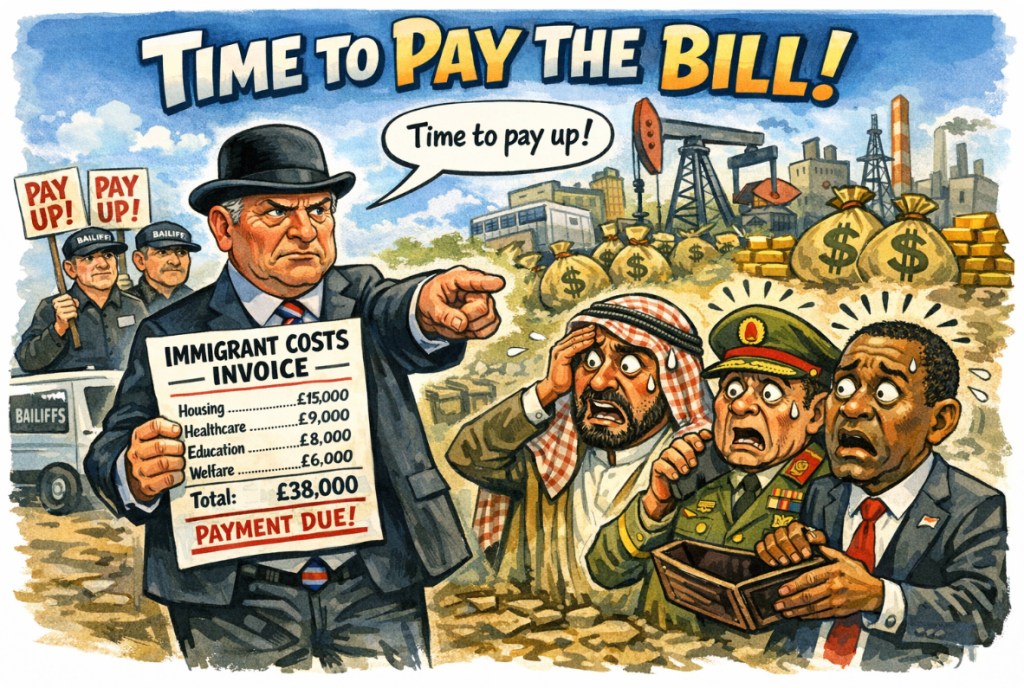
In an age where every penny of public spending is scrutinised, one question is long overdue: Why should British taxpayers carry the full cost of supporting citizens from countries that have the resources — or the responsibility — to help?
Every year, individuals from around the globe settle in the UK, and many contribute richly to society. But some also depend heavily on public services — housing, healthcare, education, legal support — especially in the early years. So, here’s the question no one in government seems brave enough to ask:
Why are we footing the entire bill, with no strings attached, while their home governments shrug off responsibility?
🌍 National Responsibility Shouldn’t End at the Border
Imagine this scenario: a country exports cheap goods, gets foreign aid, signs trade deals — but also “exports” thousands of people who end up relying on the UK’s welfare state. If that country has oil revenues, mining wealth, or a functioning tax system, why shouldn’t they contribute to the costs?
This isn’t about punishment — it’s about balance. If a country benefits from global systems, it should also be accountable when those systems are strained by its own failures.
🚧 “Challenges” Are Just Excuses Waiting for Law Changes
Some say this can’t be done because of “international law” or “human rights conventions.” But let’s be honest — laws can be rewritten. Conventions can be updated. Agreements evolve all the time. The world didn’t stop because GDPR happened.
What’s really missing isn’t legality. It’s political will.
- International law isn’t sacred text — it’s a living framework that changes when enough countries demand it.
- Humanitarian concerns can be addressed by ring-fencing aid for civilians while holding governments accountable.
- Diplomatic fallout? Countries already negotiate trade-offs every day. Aid is already used as leverage — this would just make it more honest.
🧾 What Would the System Look Like?
- A per capita reimbursement model: Track the cost of long-term welfare support provided to foreign nationals.
- Aid offsetting: Deduct the owed amount from aid packages, or suspend aid until terms are agreed.
- Trade leverage: Introduce “social cost” clauses into trade agreements, requiring cooperation on migrant accountability.
- Escalation mechanism: If a government refuses to engage, scale back diplomatic perks or public contracts.
This isn’t radical — it’s overdue.
⚖️ Fairness Must Work Both Ways
If British citizens fall behind on payments, they’re fined, sanctioned, or evicted. Businesses are regulated, taxed, and expected to clean up after themselves.
So why do entire governments get a free pass when their own people flee dysfunction and land directly into British welfare queues?
Yes — many migrants have no choice. But neither should British taxpayers be forced into unlimited generosity without reciprocal responsibility.
Are we ready to stop letting dysfunctional regimes freeload on British generosity? Are you tired of excuses dressed up as “diplomacy”? We want your serious takes in the blog comments — not just on Facebook.
👇 Like, share, and COMMENT if you believe it’s time for global cost-sharing in migration.
The top insights will be featured in the next issue of our magazine. 🧠💬


 Chameleon Magazine
Leave a comment