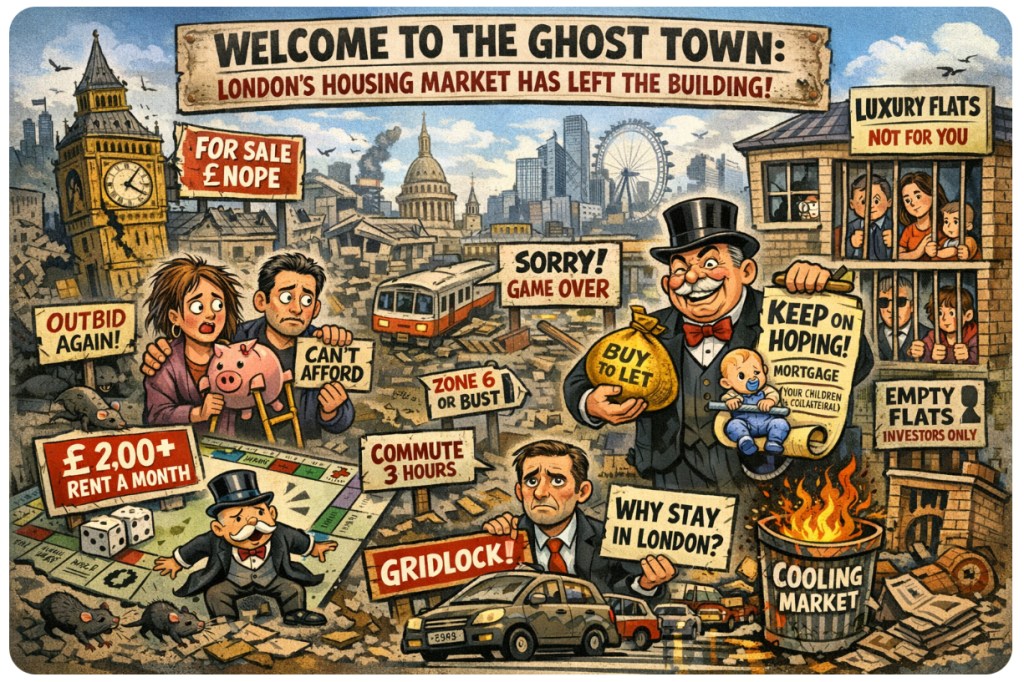
London’s housing market isn’t crashing with fireworks and falling graphs—it’s collapsing with the subtle grace of a pensioner tiptoeing out of a party they were never invited to. While economists adjust their euphemism sliders from “softening” to “cooling,” ordinary Londoners are getting economically frostbitten trying to find a flat that won’t require selling a kidney (or two).
🧊 “Cooling Market” or Full-Blown Housing Ice Age?
Let’s stop calling it a “market correction” when what we’re really witnessing is a structural faceplant. Picture a Monopoly board where all the properties are priced like Mayfair but the players earn in Monopoly Junior cash. That’s London. Buyers can’t buy. Sellers can’t sell. Developers can’t develop. Landlords can’t even pretend to be generous anymore. It’s not a cycle—it’s a silent standstill with a cocktail of dead momentum and broken dreams.
“Affordable housing” now means “sort of near a train station if you count buses as trains and ignore the black mould.” Renting feels like financial BDSM. Buying? Only possible if you’ve won the lottery or committed light financial fraud.
But don’t worry—your mortgage lender has a new “hope and prayer” scheme where you pledge your future children as collateral. 🙃
🏠 Houses as Homes? LOL. More Like Hostages.
Let’s remember what housing is supposed to be: shelter. Safety. Somewhere to live a life. But in London, it’s now a speculative asset class where the “dream of ownership” has been replaced with the “nightmare of survival.” Young families are priced out. Workers commute from counties that barely admit London exists. Investors sit on empty flats like it’s a dragon hoard of granite countertops.
And through it all, the government offers nothing but therapy speak: “It’s a cooling trend,” they say, as the fire alarm blares and the building crumbles.
The London Premium? It’s broken. All that hustle and bustle, the culture, the connections? Congrats—you now get all the inconvenience with none of the upside. Renters pay half their wages for the privilege of watching rats race them to the Tube platform.
🚫 Real Estate, Real Gridlock
The capital’s housing “system” now functions like a game of musical chairs where all the seats are bolted to the ceiling. The illusion of movement is maintained by spinning jargon while actual people can’t move house, can’t buy, can’t sell, and can’t breathe.
Oh, but prices are still technically “high,” so the headlines sleep well at night. Meanwhile, liquidity has packed its bags and booked a one-way ticket to Anywhere-But-Here.
No wonder people are asking: “Why stay in London at all?”
And when that question becomes mainstream, congratulations—you’re not living in a city. You’re stuck in a museum of failed policies with £2,000-a-month entry fees.
🧨 Challenges 🧨
What do you really think about this “not-a-collapse” housing collapse? Do these polite euphemisms infuriate you as much as trying to find a flat under £1,000 a month within Zone 3? Are you stuck renting in a converted broom cupboard or commuting 3 hours because “remote work” means “you’re lucky to be employed”? We want your rage, your sarcasm, your hot takes—don’t let this go unspoken. 💣🗣️
💬 Drop a comment. 🔁 Share with a mate still living with their parents. ❤️ Like if you’ve mentally moved to Birmingham.
🔥 The best comments get featured in our next issue of the magazine. We’ll name names and sling truths.


 Chameleon Magazine
Leave a comment