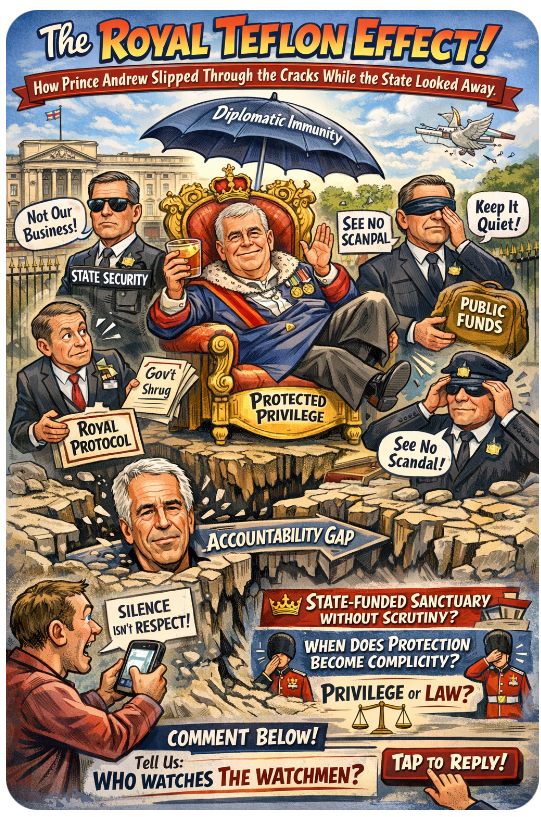
Prince Andrew’s saga isn’t just a tabloid tragedy starring one man’s catastrophic judgment. It’s a governance horror story, where the British state played butler, bouncer, and blindfolded referee — all in the name of “protocol.” This wasn’t a scandal hiding behind palace walls. It was one cushioned by government-grade insulation, fueled by public funds, and glazed over with a thick royal varnish of plausible deniability.
🕵️♂️ State-Sponsored Shrugging: How the Crown Was Shielded, Not Scrutinised
Let’s get one thing straight: no one’s saying the government hosted Epstein sleepovers at Balmoral. But when you hand a man a security detail, diplomatic clearance, and a publicly bankrolled platform — after his links to a convicted sex offender are out in the open — you’re not just ensuring safety. You’re sending a diplomatic RSVP to denial.
Prince Andrew was treated less like a liability and more like a slightly embarrassing uncle at Christmas: shuffled out of sight, but never off the payroll. The armed guards? Still there. The jet-set calendar? Lightly pruned. The accountability? Airbrushed.
It wasn’t lawbreaking that gave him cover. It was law-ignoring. The kind that wears a suit, signs off on security budgets, and whispers “this isn’t really our business.”
Turns out, the real protection wasn’t the bodyguards — it was the bureaucracy.
It’s not a conspiracy. It’s worse. It’s culture:
- The kind that bows to hereditary titles
- Tiptoes around scandal to avoid “politicising the monarchy”
- And quietly allows a royal to glide above the same scrutiny that would crush a councillor or schoolteacher
Because in the British state, there are two classes of citizen: those who need clearance to access power, and those born with a passport to impunity.
Prince Andrew didn’t game the system.
The system was designed not to game him.
Why do we keep mistaking silence for respect? 🤫💂♂️
Should royals enjoy state-funded sanctuaries without public accountability? 👀
Who decides when security becomes complicity?
Tell us in the blog comments — not just on Facebook where nuance goes to die. 💬⚖️
Start the conversation that palace PR departments hope you won’t.
👇 Tap comment. Tap outrage. Tap into the question no minister wants to answer.
The boldest takes will be featured in the next issue of the magazine. 🧨📝


 Chameleon Magazine
Leave a comment