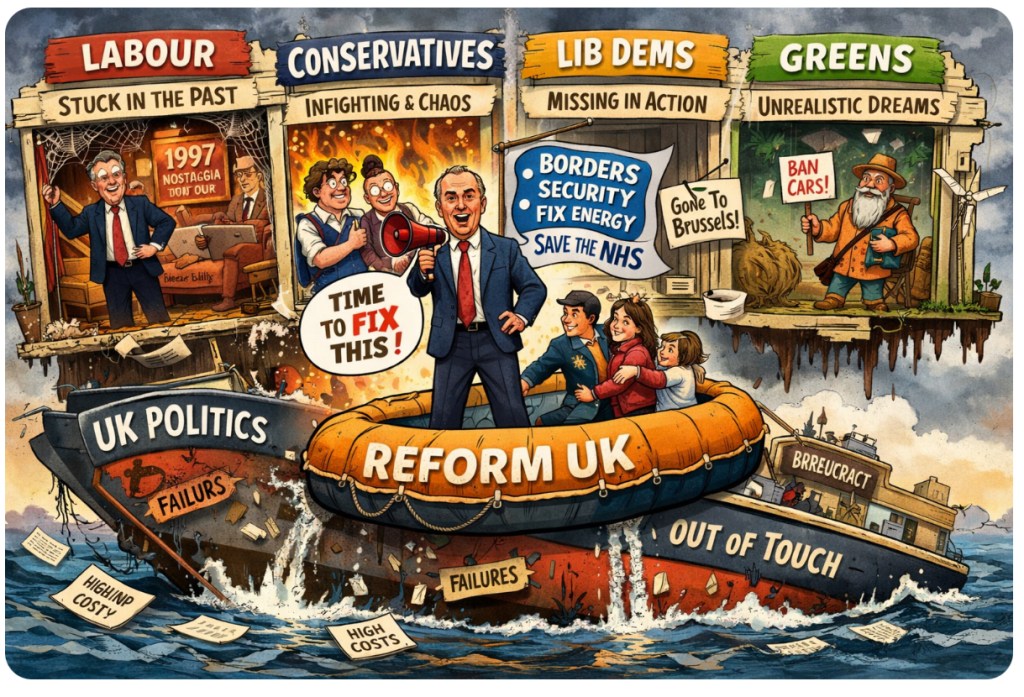
Not because it’s perfect. But because everyone else is too busy rebranding failure, relitigating history, or reading polls like horoscopes.
🧨 A National Election or a Group Therapy Session?
It’s 2026. The public isn’t foaming with rage — they’re running on fumes. And after two decades of being lied to, lectured at, and left behind, something strange has happened:
Reform UK isn’t rising because it’s extreme. It’s rising because it actually noticed the country exists.
Let’s not kid ourselves — this isn’t a political fairytale. It’s a mass evacuation from the derelict house of mainstream politics, and Reform just happens to be the only one handing out torches instead of TED Talks.
Meanwhile, what are the other parties doing?
🧻 The Political Class of 2026: A Line-Up of Absentees
• Conservatives: Once the party of government. Now the party of memory. They’ve turned into an infighting nostalgia project where every crisis is solved by sacking someone or announcing a “bold reset” with the same 12 MPs playing musical chairs. They’ve gone from “strong and stable” to “weak and wobbly” to “please stop asking us questions.”
• Labour: Still traumatised by its own reflection. The party that should be surging in a crisis has decided to run a campaign built on not scaring anyone. It’s all beige promises and fear of saying anything real. Leadership? Maybe. Conviction? You’d have better luck finding it in a self-help section.
• Liberal Democrats: The political equivalent of a screensaver. Occasionally colourful, rarely relevant. They pop up every five years to talk about Europe and electoral reform before vanishing back into a WhatsApp group about quinoa.
• Greens: Admirably principled. Fatally unserious. They’ve got real points to make — but no idea how to sell them without sounding like they’re writing a sci-fi novel about banning cars and nationalising vegetables.
In this vacuum of purpose, Reform doesn’t look radical. It looks like it read the brief.
Immigration. Energy. Public services. Cost of living. The things people deal with daily, while the old parties scroll Twitter and film campaign videos nobody watches.
🧊 It’s Not a Wave — It’s a Walkout
This isn’t about “populism.” It’s about absence.
Critics of Reform like to frame its support as brainwashed backlash. But here’s the real story: Reform isn’t pulling people away. The other parties are pushing them out.
This is what happens when the entire political establishment treats the electorate like a customer service burden. You don’t get a revolution. You get a quiet, steady opt-out. And the only ones left standing are the ones who didn’t flinch from speaking plainly.
Until another party learns how to speak to voters like adults and not demographic “buckets,” this trend only gets louder.
🔥 Challenges 🔥
Which party lost you first? Was it the Tories with their implosion parade? Labour and its policy witness protection scheme? Or the Lib Dems and their vanishing act? Sound off in the blog comments, not just Facebook. Let’s make it sting. 🧨💬
👇 Comment. Like. Share with someone who’s politically homeless and mad about it.
**Top scorched takes get featured in the next magazine issue.**🔥📣


 Chameleon Magazine
Leave a comment