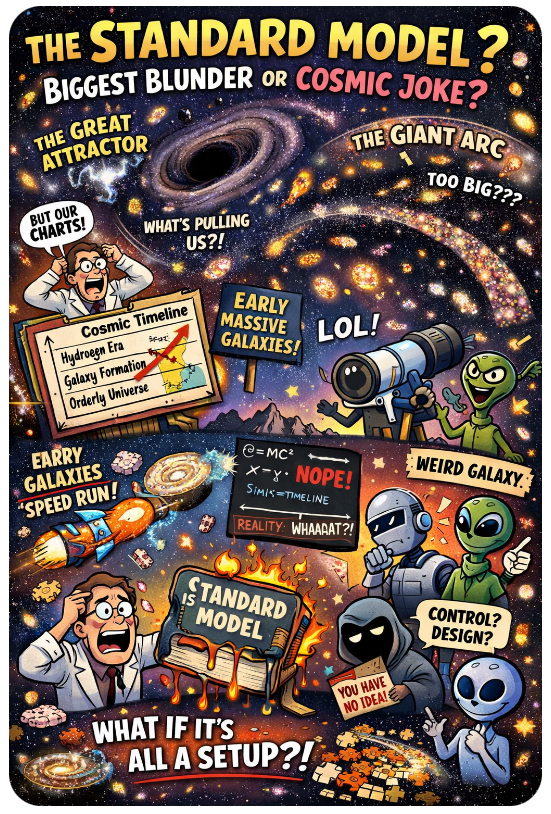
Did the Standard Model Faceplant the Cosmos? Or Is the Universe Just Laughing at Us?
🌌🤯The Standard Model was supposed to be the instruction manual for reality. Instead, the universe keeps flipping the table, inventing gravity weirdos, speed-running galaxy formation, and flexing structures so big they make our equations whimper. 🌌🤯
The Standard Model was supposed to be the instruction manual for reality. Instead, the universe keeps flipping the table, inventing gravity weirdos, speed-running galaxy formation, and flexing structures so big they make our equations whimper.
When the Universe Refuses to Follow the Spreadsheet
Let’s address the cosmic elephant in the observatory: the universe was meant to be random-ish, gently bubbling along from hydrogen soup to polite little galaxies over billions of years. Instead?
Galaxies show up early, jacked on mass, already organised like they skipped the tutorial level.
Some galaxies drift away politely in an expanding universe, while others appear to be yanked toward something ominous and invisible—hello, Great Attractor, the gravitational equivalent of “don’t worry about it.” We can’t see it, can’t map it cleanly, but it’s hauling entire clusters like a cosmic tow truck with no license plate. 🚛✨
And then there’s the Giant Arc—so obscenely large it blows past the supposed size limits cosmologists assured us were definitely, absolutely, no-take-backs real. Turns out the universe didn’t read that paper.
Oh, and let’s not forget the oddball galaxies—the ones that don’t fit the narrative. Different shapes. Wrong ages. Unexpected chemistry. The kind of stuff that makes scientists cough politely and say, “Interesting… but probably an error.” Scientists love discovery—until it ruins the model they just finished defending at a conference.
🧠 The Timeline That Got Mugged by Telescopes
We were promised a neat cosmic history:
- Hydrogen era ✔️
- Slow clumping ✔️
- Gradual galaxy formation ✔️
- Order, patience, elegance ✔️
Then modern telescopes showed up and went: “lol, no.” 🔭💥
Suddenly we’re seeing massive galaxies way too early, structures way too big, and complexity way too fast. The universe wasn’t meandering—it was speedrunning existence like it knew exactly what it was doing.
Which raises the uncomfortable question no one likes to say out loud:
👉 Was there more organisation… or even constraint… than we accounted for?
👉 Is randomness just a comforting myth we tell ourselves when math breaks?
Because if the universe isn’t chaotic—but selective, directional, or structured beyond our equations—then the Standard Model isn’t just incomplete. It’s cosmically naive.
🔥 Challenges 🔥
So what is it:
Is the Standard Model the greatest scientific achievement of our time—or the most sophisticated case of confirmation bias ever funded? 💸🧪
Are we witnessing cracks in the foundations… or just refusing to admit the house needs rebuilding?
Drop your thoughts in the blog comments (not just social media drive-bys). Argue. Rant. Speculate wildly. The universe clearly doesn’t care about our comfort—why should you? 💬🔥
👇 Comment. Like. Share. Shake the model.
The sharpest, boldest, and most unhinged comments will be featured in the next magazine issue. 📝🚀


 Chameleon Magazine
Leave a comment