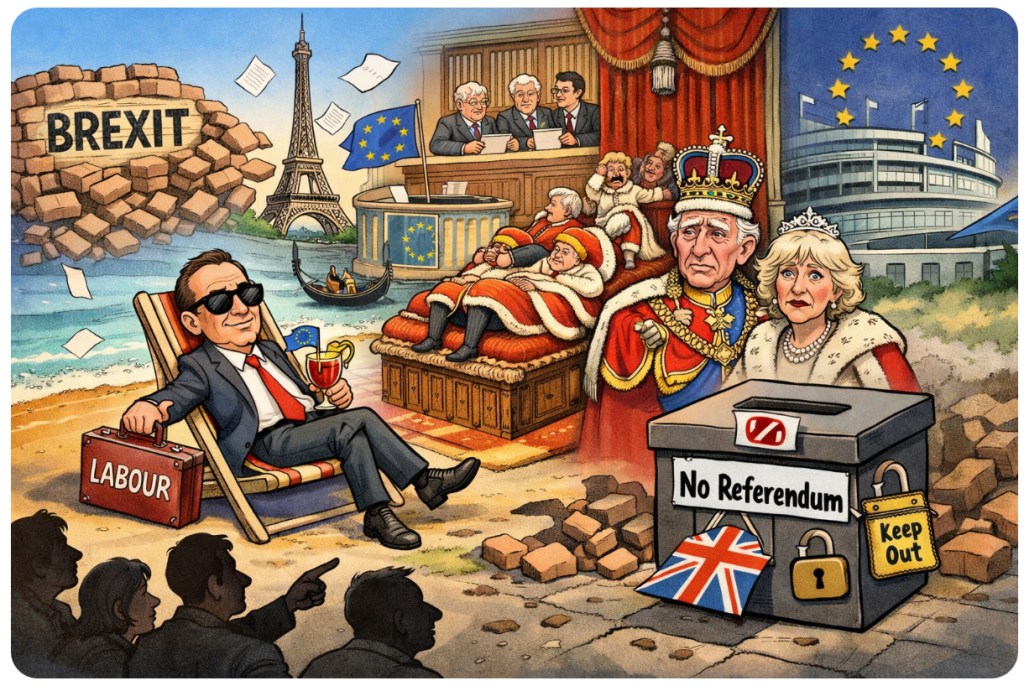
There is a growing sense that the Labour Party wants to edge Britain back toward Europe—not through a clear mandate, but through quiet alignment, bureaucratic re-entry points, and strategic ambiguity. This is not presented as a bold democratic project. It is framed as “pragmatism.” In reality, it looks suspiciously like convenience.
Europe as a Comfort Blanket for Politicians
One of the unspoken attractions of closer European integration is that it reduces the burden of national decision-making. The European Union excels at centralised regulation, shared frameworks, and slow-moving consensus. For ministers, this means fewer hard domestic choices and more opportunities to defer responsibility upward.
If policy can be attributed to “European standards” or “alignment requirements,” accountability becomes diffuse. Ministers travel, attend summits, issue statements—and the machinery grinds on elsewhere. It is governance with less ownership and, crucially, less political risk.
The Contradiction of the House of Lords
Labour frequently criticises Britain’s unelected institutions, yet when discussing constitutional reform in the context of Europe, the logic collapses. There is talk of reforming or even abolishing the House of Lords, but no serious commitment to doing so if sovereignty is increasingly shared with the European Parliament.
If European institutions are to hold legislative authority, what exactly is the democratic role of an unelected second chamber at home? The answer appears to be: keep it anyway. Not because it makes sense, but because it suits those already inside the system.
The Monarchy Question No One Wants to Ask
European governance does not require a monarchy. Most EU states are republics. If Britain were truly re-engineering its constitutional settlement to align with Europe, the relevance of the British Royal Family would inevitably come into question.
Yet Labour avoids this entirely. The monarchy is neither defended on principle nor challenged on logic—it is simply subcontracted as a ceremonial brand. Kings and queens become pageantry, detached from real power, preserved because confronting the issue would require honesty about what kind of state Britain is becoming.
You cannot argue for modernisation while ring-fencing medieval institutions for convenience.
The Democratic Deficit: No Vote, No Consent
Most importantly, any return toward Europe—formal or informal—demands public consent. Britain voted to leave. That decision may be controversial, regretted by some, or disputed in hindsight, but it was explicit.
Re-entry by stealth—through regulatory alignment, judicial overlap, or political drift—is not democratic correction. It is avoidance. If the case for Europe is strong, it should be made openly and put to the people in a referendum. Anything less treats voters as an obstacle rather than the authority.
Conclusion: If You Want Back In, Say It
If Labour believes Britain’s future lies closer to Europe, it should say so plainly. Explain the trade-offs. Acknowledge the loss of autonomous decision-making. Address the constitutional contradictions. And, above all, ask the public.
What undermines trust is not Europe itself—it is the sense that decisions of national magnitude are being nudged through side doors by people who prefer conferences abroad to accountability at home.
If this is about the future of the country, it belongs to the voters. Not to quiet meetings, inherited institutions, or political convenience.


 Chameleon Magazine
Leave a comment