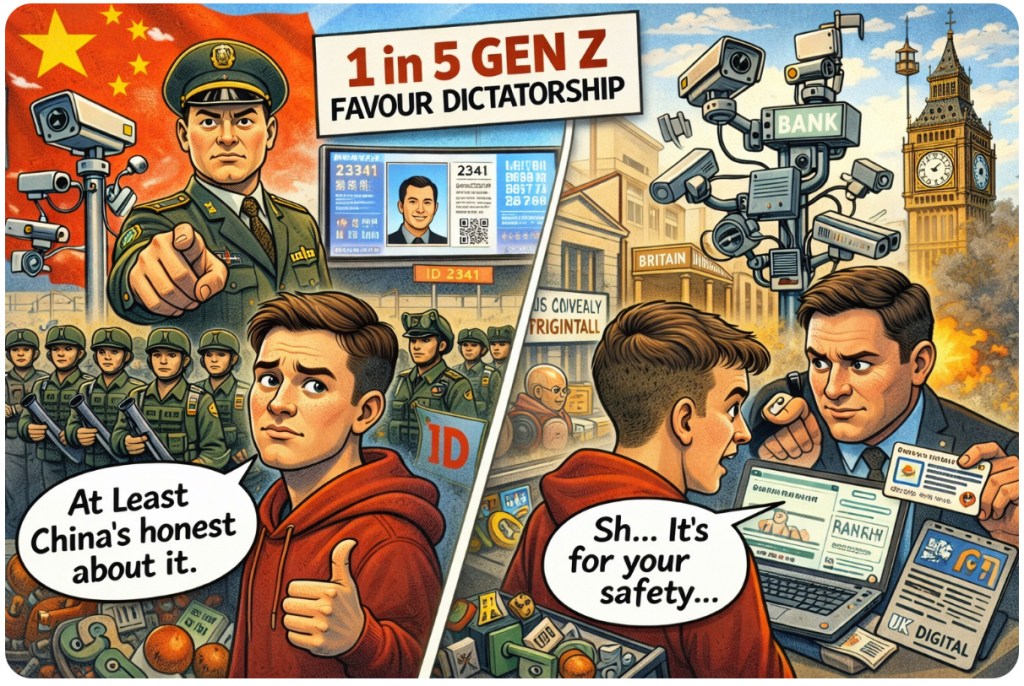
Nearly one in five Gen Z Brits flirting with the idea of dictatorship sounds shocking—until you remember they’ve grown up being watched, tracked, logged, nudged, and “algorithmically protected” since birth. To them, democracy doesn’t feel free. It feels monitored with better branding.
The survey says young people want a “strong leader who doesn’t bother with elections.” What it really says is this: if we’re already being controlled, at least don’t insult us by pretending we’re not.
🕶️ Transparent Tyranny vs Sneaky Surveillance
Take China. No one’s confused there. Cameras everywhere. Digital IDs. Social credit. Everyone knows the rules, the risks, and the red lines. Brutal? Yes. Honest? Also yes.
Now compare that with United Kingdom—where surveillance arrives quietly, wrapped in words like “efficiency,” “safety,” and “streamlining services.” Cameras pop up on lampposts. Bank accounts get flagged. Transactions get sniffed. And when people ask questions, they’re told it’s for their own good and definitely not happening anyway.
Schrödinger’s Surveillance State: it both exists and doesn’t, depending on whether you’re reading the small print.
Then comes the shiny new ID system—sold as convenience, pitched as protection, and destined to become yet another layer of control. Not to replace freedom, of course. Just to manage it. Carefully. Centrally. Permanently.
So when Gen Z looks at this setup and shrugs at the idea of dictatorship, it’s not because they love authoritarianism. It’s because they already feel like they’re living in one—just with worse Wi‑Fi and better PR.
Democracy, in theory, is participation. Democracy, in practice, now feels like voting once every few years while unelected systems quietly make all the real decisions. Algorithms don’t campaign. Databases don’t lose elections. And cameras don’t need your consent—they just need electricity.
🚨 Challenges 🚨
If you’re watched, tracked, and financially monitored anyway… does the label still matter? Is the real problem dictatorship—or dishonesty? And at what point does “for your safety” start sounding like “because we can”?


 Chameleon Magazine
Leave a comment