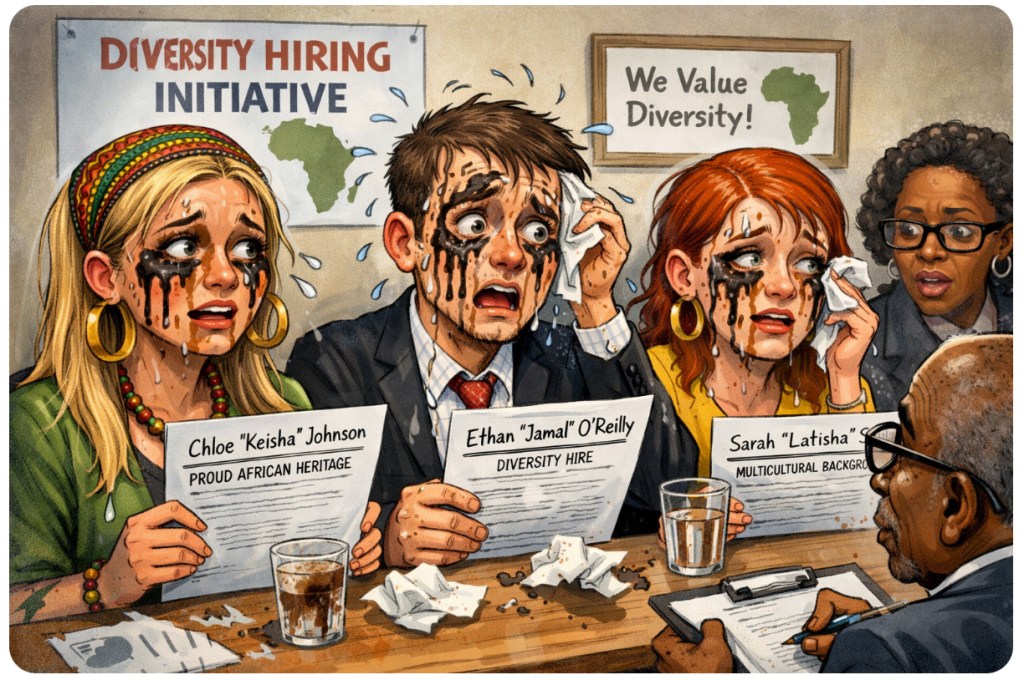
In the never-ending theatre of performative diversity, a new character has entered stage left: the “Just Enough Melanin to Mention It” jobseeker. Yes, folks, it seems that in a desperate bid to out-diverse the competition, students are now retrofitting their ancestry to squeeze out a drop of African heritage like it’s the last squeezy ketchup packet at a dry chicken shop.
Apparently, it’s not about who you are anymore—it’s about who you can plausibly pretend your great-great-uncle once dated. Because when governments start setting diversity quotas like workplace Pokémon collections, who’s shocked that the CV has become a battleground of creative genealogy?
🧬 From 23andMe to “Hire Me!”—The Diversity Gold Rush
So here we are, watching white students rewrite their DNA like it’s a personal brand. “I recently discovered I’m 1/64th Mozambican on my step-grandmother’s side,” says Josh from Surrey, now identifying as Afro-Euro-fluid. Suddenly every second gap year sounds suspiciously like a roots pilgrimage, and every family tree is sprouting baobab branches.
But let’s be clear—this isn’t about genuine multicultural pride. It’s about dodging the penalty of being “just white” in a hiring landscape that’s trying to course-correct centuries of inequality with awkward spreadsheet metrics. And rather than fix the systemic issues, we’re just gamifying identity.
Welcome to the identity Hunger Games: may the most convincingly intersectional CV win.
Meanwhile, actual Black and brown candidates still face systemic barriers, racist assumptions, and workplace tokenism. But sure, Becky “Mbatha” with the dashiki earrings gets the internship at the social justice non-profit. 🎯
We’ve officially reached the point where diversity is being commodified like avocado toast—desirable, marketable, and subject to heavy appropriation.
🔥 Challenges 🔥
Are we fixing racism, or just repackaging it for LinkedIn? What happens when diversity becomes a performance, not a principle? Have you seen examples of this identity inflation trend? 👀


 Chameleon Magazine
Leave a comment