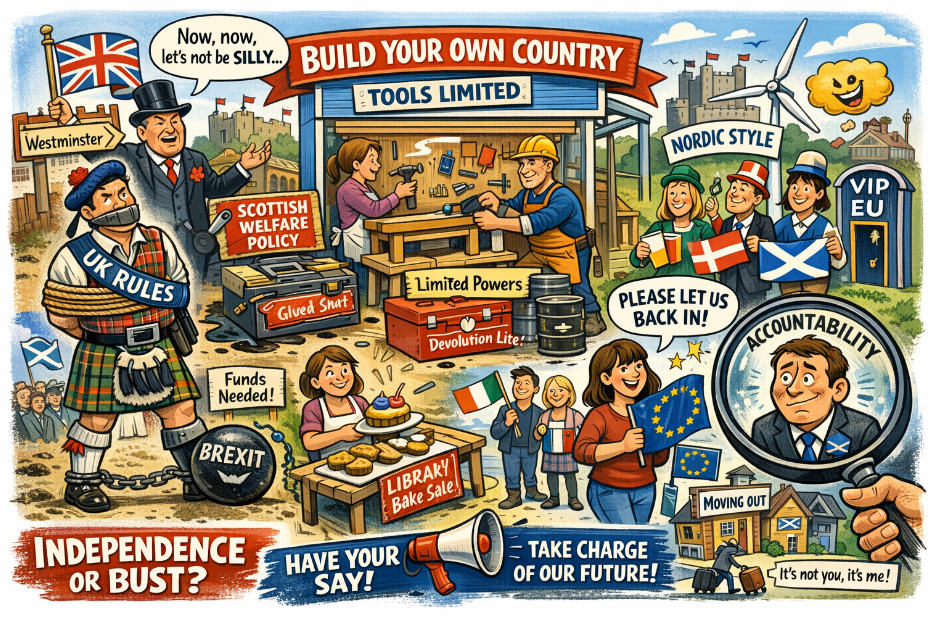
Turns out, wanting to run your own country isn’t a rebellious tantrum—it’s just…basic.
🗳️ Welcome to the Nation Formerly Known as “Region”
Scotland, a place with its own parliament, its own legal system, its own accent (or five), and apparently, its own voting preferences—has the gall, the audacity, the sheer common sense to suggest that it might want a government that, brace yourself… actually reflects what it votes for. Revolutionary.
Let’s take a wild Highland guess: if a nation votes against Brexit and still gets Brexited, maybe—just maybe—it’s not running its own show. And if decade after decade it gets Tory governments it didn’t vote for, could that possibly be a teensy problem for “democracy”? Nah, must be fine. Rule Britannia.
Meanwhile, every time Scotland suggests independence, Westminster responds like a Victorian dad told his daughter wants to open a bank account: “Now, now, let’s not be silly.”
🏗️ Build Your Own Country: Some Assembly Required
Devolution? Cute. It’s like handing someone a toolbox, but gluing all the drawers shut. Sure, Scotland can do some stuff—like fix potholes and argue about ferries—but tax, welfare, immigration, pensions, energy strategy? That’s reserved for Big Daddy UK, thanks.
Supporters of independence suggest something wild: let Scotland set its own priorities. Like solving demographic decline with sensible immigration policy. Or building a Nordic-style welfare state instead of copy-pasting austerity blueprints from Westminster’s midlife crisis binder.
Because nothing screams “healthy governance” like Scotland sending oil revenues south while trying to keep libraries open on a bake sale budget. 🍰📉
💰 From Oil Rigs to Wind Farms: Show Us the Receipts
Apparently, Scotland has resources. Like actual ones. Oil, wind, whisky, tourism, tidal power, and people who know what a “life science” is. But right now, those resources are harnessed via a fiscal framework that’s less “tailored” and more “straightjacket.”
Independence means being able to borrow, invest, and design an economy that isn’t based on the needs of the Home Counties and London’s property ladder.
And let’s be clear: no one’s saying it’s easy. But if “too hard” was a reason not to do something, half of Britain wouldn’t have tried to microwave democracy with Brexit.
🇪🇺 Please Let Us Back In, We’re Not All Like That
Scotland voted 62% to remain in the EU, and ever since, it’s been stuck in a toxic relationship with a partner who changed the locks and joined a Facebook group called “Sovereignty for Big Boys.”
Rejoining the EU isn’t just about trade—though that matters. It’s about research funding, skilled migration, and not being treated like the moody cousin at Christmas dinner who thinks passports are woke.
Small independent states—think Ireland, Denmark, Estonia—seem to manage just fine. They get a seat at the grown-up table while Scotland watches from the kids’ bench, wearing a Union Jack bib and pretending it likes baked beans.
🔍 Accountability? In THIS Economy?
Supporters of independence suggest another scandalous idea: politicians being accountable to the people who elected them. Weird, right?
When things go wrong, you can’t just blame “London.” You’re it. The buck stops where the bagpipes start. Transparency improves when there’s nowhere to hide behind another layer of bureaucracy.
It’s not about nationalism—it’s about civic responsibility. A concept so rare in UK politics it might qualify for a museum display next to “honourable resignations” and “fully funded manifesto pledges.”
🧾 Independence Isn’t a Break-Up—It’s a Rebrand
Finally, let’s pop the biggest myth balloon in the room: independence doesn’t mean cutting all ties and floating off into the North Sea with a saltire sail and a Spotify playlist called “Braveheart Bangers.”
It means becoming what most countries already are: independent, interdependent, and a little bit annoying at Eurovision. 🇪🇺🎤
Scotland can still love its neighbours while choosing its own flat. Think of it as moving out of a shared house where one guy keeps voting for flat earth policies and canceling the Wi-Fi. You’ll still visit. You’ll just finally have your own key.
🔥 Challenges 🔥
Why shouldn’t a nation govern itself? Why is normalisation still treated like rebellion? And how long do we keep calling it “devolution” when it looks more like diet autonomy with all the flavour stripped out?


 Chameleon Magazine
Leave a comment