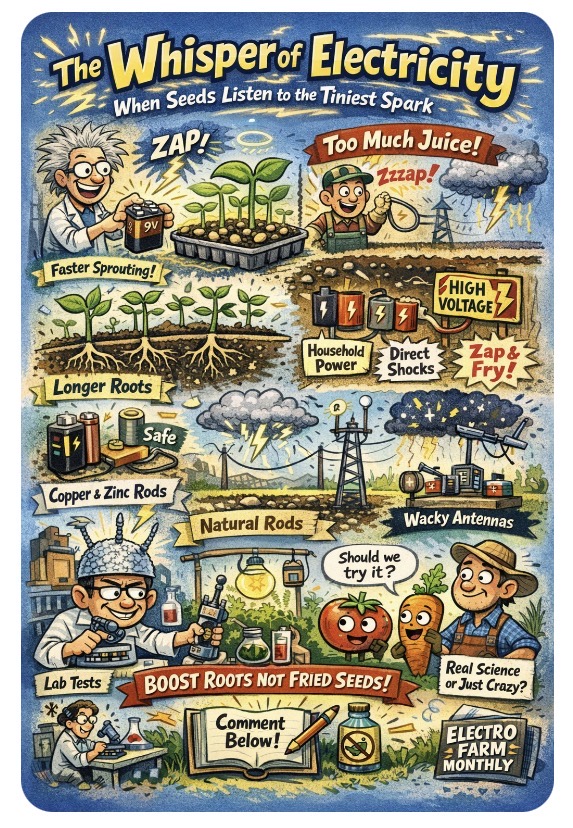
🌱✨Forget fertilizer worship — your seedlings might just want a soft, electrified lullaby.
🌩️ Tiny Zaps, Big Dreams: Welcome to the Age of Botanical Buzz Therapy
While most farmers are drowning their soil in nitrogen like it’s a frat party for plants, a quieter revolution is humming in the background — literally. It’s called electrical stimulation, and it turns out, seeds are secretly into it. Not the shocking kind. We’re talking millivolts, baby. The kind of current that politely knocks instead of blowing the door off its hinges. 🚪⚡
Here’s the botanical gossip:
Seeds are electrochemical creatures. Their membranes, their enzymes, their early growth? All running on ion traffic like a microscopic rave. A faint electrical nudge — carefully applied — kicks this process into hyperdrive. Researchers have clocked:
- ⏩ 10–30% faster germination
- 🌿 More uniform sprouting (no more lazy lettuce)
- 🌱 Longer, hungrier roots
- 🪴 Beefier baby plants
- 🧪 Sometimes, even yield boosts (depending on the plant, not your vibes)
But don’t confuse this with some Tesla-powered tomato fantasy. This only works in the seed-to-seedling stage. After that, it’s back to soil, water, and sunlight — the unsexy basics.
🧯 When Farmers Turn Mad Scientists (and Blow Up Their Beans)
A little electricity helps. A lot turns your seed tray into a smoldering graveyard. Let’s break down what’s not cool:
- Mains electricity: Unless your plan is “fried rice” before planting.
- Direct shocks to plants: That’s plant abuse.
- “More volts = more growth”: No. That’s how you kill your salad.
Electricity ≠ Miracle-Gro on steroids. It’s acupuncture, not open-heart surgery. 🪡⚠️
✅ What Works (And Won’t Result in a Visit From the Fire Department)
- Seed pre-treatment: 1–5V, a few seconds to a couple minutes. Controlled. Clean. Classy.
- Passive electroculture: Metal rods (copper/zinc) in soil. Uses natural micro-currents. Very safe. Very slow.
- Atmospheric antennas: Lightning whisperers. Collect ambient charges, deliver faint soil stimulation. Like tuning a radio to “plant vibes.” 📻🌾
🧨 Why This Isn’t Standard Practice (Yet)
- Too subtle for impatient farmers
- Results depend on species (carrots might love it, kale might yawn)
- Hard to scale outdoors
- Modern fertilizers deliver bigger yields (but fewer sparks)
- Pseudoscientific electroculture bros poisoned the PR well 🤡
Still, in greenhouses and labs, the whisper of electricity is real — and it’s working.
🔥 Challenges 🔥
Why is the Tesla of tomatoes stuck in the lab while TikTok charlatans wave wires at compost? Why did gentle, proven tech get lumped in with tinfoil conspiracies? And would you zap your seeds if it meant bigger roots and faster growth? Drop your thoughts, experiments, or rants in the blog comments. 💬⚡


 Chameleon Magazine
Leave a comment