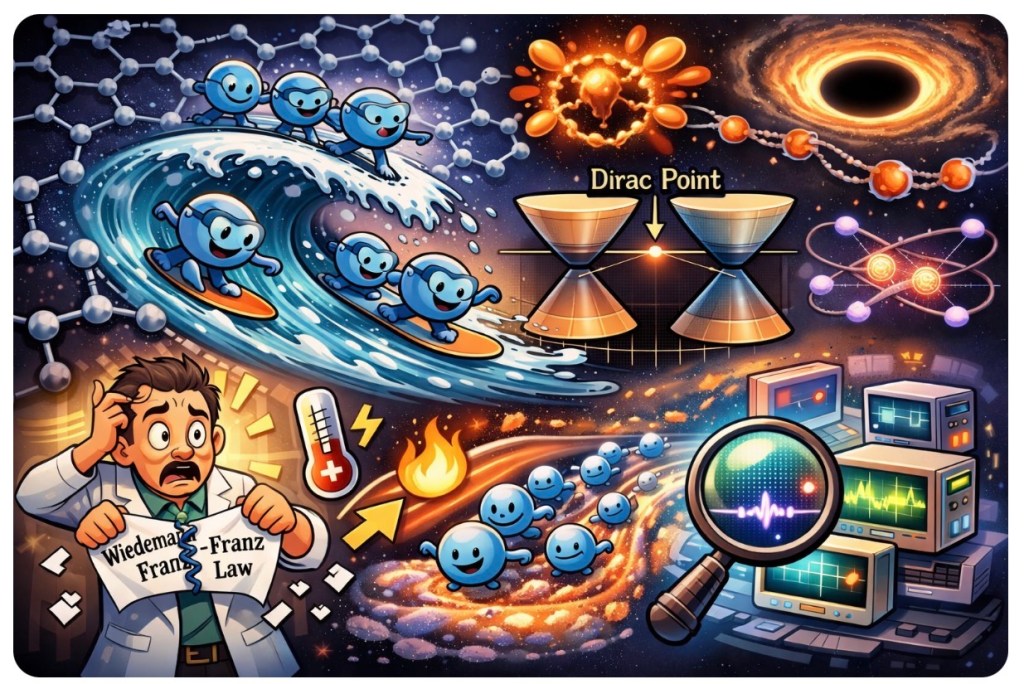
Electrons in a single sheet of carbon have politely ignored 100+ years of physics textbooks and started flowing like a near-perfect quantum liquid—smoother than anything we’ve ever seen in solid matter.
🚨 When Electrons Decide to Unionize 🚨
At graphene’s Dirac point—that awkward existential phase where it’s not quite a metal and not quite an insulator—electrons stopped acting like rugged individualists and started moving together. Not bumping. Not scattering. Flowing. Like water. But eerily better behaved.
Physicists measured an electron viscosity so low it’s closer to the early-universe plasma smashed out inside particle colliders than anything normally found in a solid. Let that sink in: a one-atom-thick sheet of carbon is cosplaying as the birth of the cosmos. 🌌
And then came the real scandal.
Heat and electric charge—best friends since the 19th century—broke up.
The sacred Wiedemann–Franz law, taught as gospel in every physics class, didn’t just bend. It shattered. Graphene’s quantum fluid violated it by over 200× the expected value—the largest breakdown ever measured.
This isn’t a rounding error. This is physics screaming, “We need new rules.” 📉💥
Suddenly graphene isn’t just a material—it’s a desktop portal into black hole math, quark–gluon plasma behavior, and quantum entanglement, all without billion-dollar accelerators or astrophysical catastrophes. Just carbon. Being rude.
And yes, there’s a practical angle (because chaos must eventually be monetized):
This ultra-clean quantum behavior could unlock absurdly sensitive sensors, capable of detecting electrical or magnetic signals so faint they’d make current tech cry in silicon shame. 🔍⚛️
🔥 Challenges 🔥
If a single atomic layer can overthrow century-old laws, what else are we pretending is “settled science”?


 Chameleon Magazine
Leave a comment