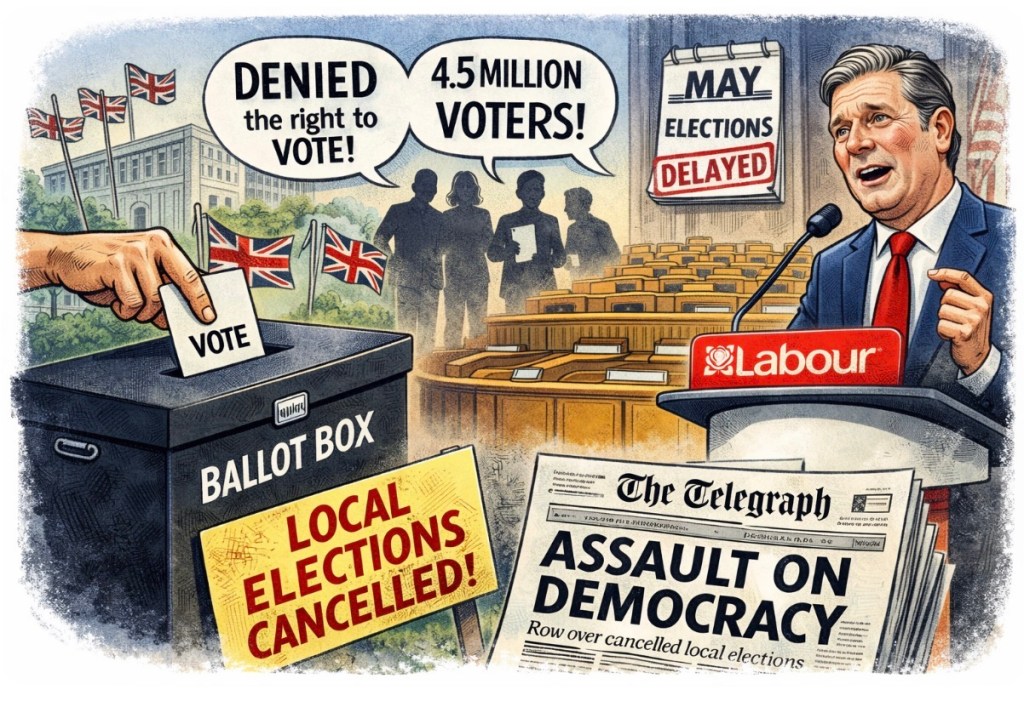
🗳️⏸️Never before have British elections been cancelled on this scale, for reasons so thin you could read party strategy notes through them. Yet here we are: millions sidelined, ballots boxed away, and democracy told to “wait a bit.”
🚨 Democracy, Delayed — For Your Convenience
In a move that sounds less like governance and more like risk management, Labour Party has announced plans that will deny 4.5 million people a say in who controls their local authorities. Two of the country’s largest councils have already been waved through to delay May elections, with a third hovering at the door like it’s waiting for planning permission.
This isn’t a minor administrative tweak. It’s an unprecedented pause button slapped on local democracy—justified with language so vague it could double as a horoscope. “Reorganisation.” “Transition.” “Efficiency.” The holy trinity of words that usually mean don’t ask too many questions.
📰 Cue the Alarm Bells (and the Newsprint)
Unsurprisingly, The Telegraph isn’t buying it. With its campaign to restore British democracy ramping up, the paper’s Chief Political Correspondent Nick Gutteridge has laid out what many suspect: this looks less like necessity and more like an assault on voting rights, carried out with a straight face and a spreadsheet.
Because if you can cancel elections without a national emergency, what exactly can’t be postponed? Local accountability? Public consent? The awkward possibility of losing? Asking for 4.5 million friends.
This isn’t about left or right—it’s about whether elections are a fundamental right or a scheduling option. When democracy becomes optional, it usually isn’t the voters doing the opting.
🔥 Challenges 🔥
If this happened anywhere else, what would we call it? Administrative tidying—or democratic erosion with a clipboard? Should voters accept being benched “for their own good,” or is this the moment to make some noise? Take it to the blog comments—not Facebook—and say what you actually think. 💬🔥


 Chameleon Magazine
Leave a comment