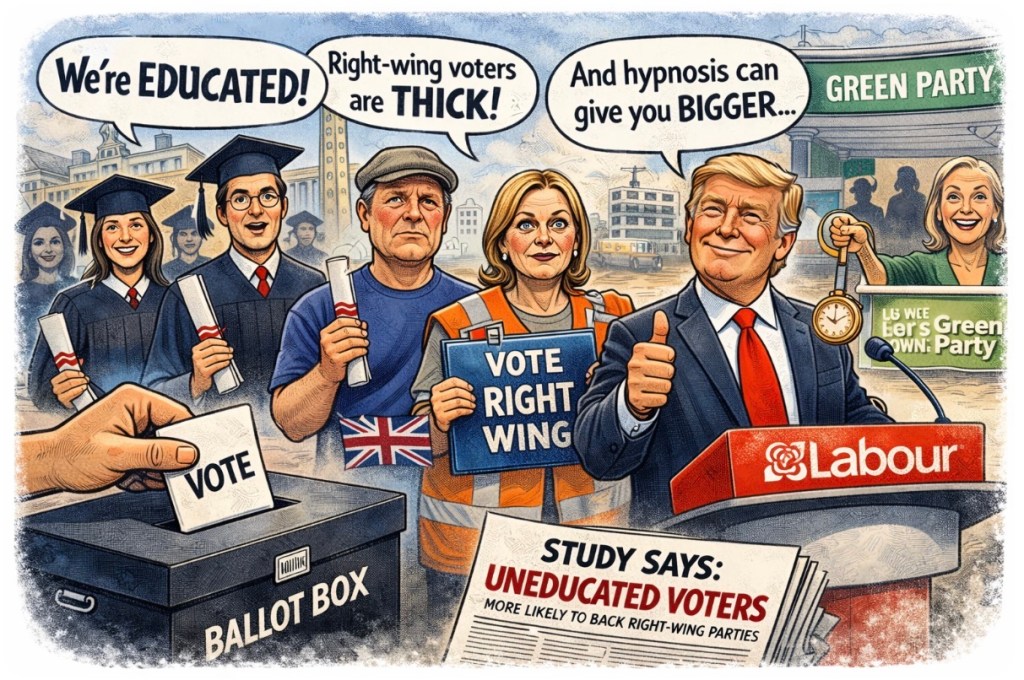
🎓🗳️A new study has landed, and with it comes that familiar whiff of establishment smugness: if you didn’t go to university, you’re probably voting wrong.
🧠 Educated Guesswork and Classy Insults
According to research from the National Centre for Social Research (NatCen), right-wing movements are struggling to win over graduates, while support is stronger among people with qualifications below A-level. This has been eagerly translated in polite circles as “education is the key dividing line in modern Britain.”
Translated less politely, it becomes: the thicker working class are the problem.
No one says it outright, of course. That would be gauche. Instead, it’s wrapped in sociological language, charts, and earnest concern—while quietly implying that millions of people are voting out of ignorance rather than experience. As if disagreement is a learning disability. As if politics were a GCSE you failed once and should now keep quiet about.
🌍 Meanwhile, Across the Pond…
What’s especially awkward is that this narrative collides head-on with reality elsewhere. In the US—where large numbers of non-graduate, working-class voters backed Donald Trump—economic indicators in manufacturing, energy, and border enforcement have shown measurable shifts. You might hate the man, loathe his tone, or wince at his social media habits—but pretending nothing changed doesn’t make it true.
Yet here in Britain, any suggestion that working-class voters might be responding rationally to lived experience—wages, housing, migration pressure—is treated like a conspiracy theory scribbled on the back of a bus ticket.
🌱 And Then There’s the Alternative…
On the other end of the spectrum, the Green Party of England and Wales continues offering a vision of politics that feels less like policy and more like lifestyle branding—complete with eyebrow-raising promises that sometimes sound better suited to a wellness retreat than a government manifesto.
Apparently, we’re to believe that the future lies not with voters who build things, fix things, or keep the lights on—but with people who’ve mastered the art of sounding morally correct while delivering very little that survives contact with reality.
🔥 Challenges 🔥
When did “working class” become shorthand for “uneducated nuisance”? Are voters wrong—or are analysts simply uncomfortable with answers they don’t like? And is democracy about listening, or about lecturing? Take it to the blog comments (not Facebook) and say what everyone else is thinking. 💬🔥


 Chameleon Magazine
Leave a comment