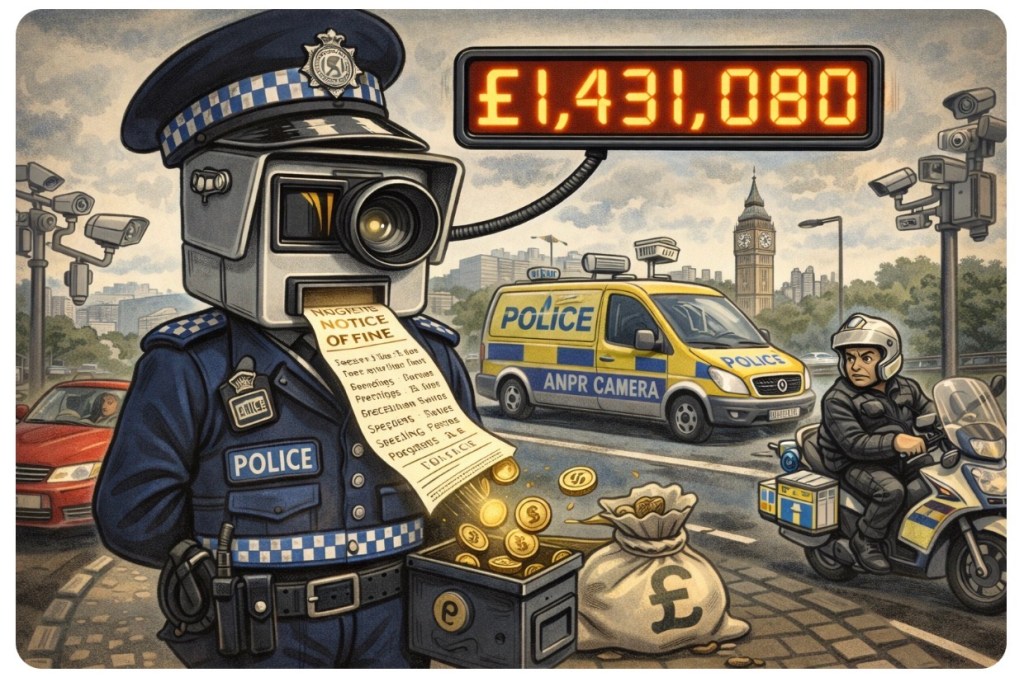
🚓💷Once upon a time, the police were seen as guardians of public safety. Now, to a growing chunk of the public, they look suspiciously like outsourced tax collectors with flashing lights and a direct debit mandate.
🤖📸 Smile for the Camera — You’ve Just Been Invoiced
Let’s say the quiet part out loud: many people no longer experience the police as problem-solvers. They experience them as fine distributors.
More surveillance than ever. More cameras than officers. ANPR vans lurking like metallic anglerfish. Speed cameras that don’t slow traffic, don’t redesign dangerous roads, don’t improve behaviour—but do reliably generate revenue. And when the fine lands? Good luck arguing with the robot. 🤷♂️
This isn’t law enforcement; it’s automated punishment.
The public notices the shift. They see police time poured into low-risk, high-yield offences while burglaries get crime numbers, antisocial behaviour gets shrugged off, and violent incidents get “log-and-monitor.” The message received isn’t “we’re keeping you safe”—it’s “you’re a balance sheet with legs.”
And yes, cameras make mistakes. Plates misread. Context ignored. Emergency braking punished. But the burden to fix it lands squarely on the citizen, who must navigate a bureaucratic maze to prove they’re innocent to an algorithm that never doubts itself. Justice by spreadsheet. 📊⚖️
This is where trust erodes. Not with a bang, but with a brown envelope.
Policing by consent collapses when consent feels irrelevant—when enforcement feels less like deterrence and more like harvesting. The danger isn’t just resentment; it’s disengagement. People stop seeing the police as their police and start seeing them as an arm of the Treasury with sirens.
And once that perception sets in, no reshuffle of chief constables will fix it.
🔥 Challenges 🔥
When did safety take a back seat to surveillance? Are fines actually changing behaviour—or just funding a system that no longer bothers fixing the underlying problems? Have the police become guardians of order… or collectors of compliance? Tell us what it feels like on your street in the blog comments. 💬🚨


 Chameleon Magazine
Leave a comment