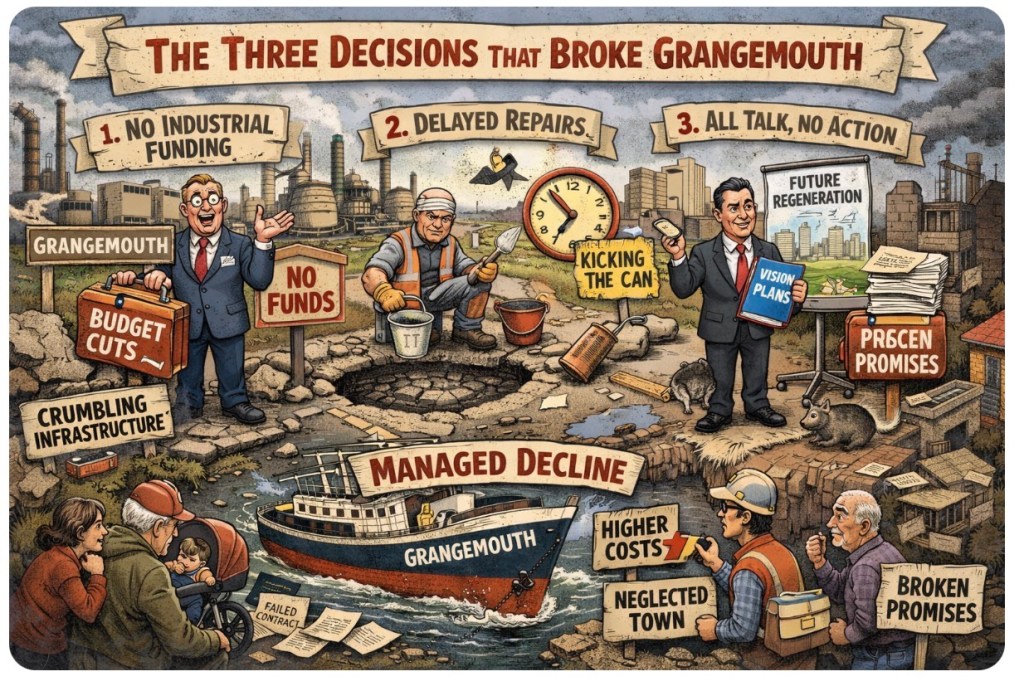
🏭💸It wasn’t a collapse. It was a quiet demolition by spreadsheet — one budget line at a time.
🧾 Welcome to the UK’s Favourite Budget Scapegoat Town
Grangemouth wasn’t struck down by fate. It wasn’t swallowed by a sinkhole or flattened by Godzilla. What happened here was worse — because it was designed.
Behind the PR-friendly phrases like “budget efficiencies” and “strategic priorities” was a ruthless triage: preserve appearances, protect senior decision-making freedom, and pray the industrial town didn’t scream too loud while it crumbled.
And it worked. For years. Until now.
Let’s take a look at how Falkirk Council managed to not support Scotland’s industrial engine — and instead, quietly run it into the ground. 🏚️💀
🏗️ Decision One: Industry? Yes. Funding? LOL, No.
Grangemouth is the beating heart of Scottish industry — but it got budgeted like a sleepy suburb with a Costa and a Coop. The town hosted chemical plants, oil refineries, and 40-tonne HGVs rumbling daily through its streets… but somehow, never qualified for a dedicated industrial upkeep fund.
Imagine forcing an athlete to run marathons in flip-flops while the coaching team insists he has the same shoe budget as the yoga class. That’s Grangemouth.
Other councils fought for uplifts and ring-fenced funds. Grangemouth got the financial equivalent of a shoulder shrug and a half-used pothole filler.
The result? Infrastructure aged in dog years, while the council patted itself on the back for “treating all wards equally.” 🎖️🛞
🛠️ Decision Two: The “Just Patch It” Policy That Blew Up the Books
Deferred maintenance is the fiscal version of eating your arm to save your leg — and Falkirk Council was famished.
To balance the books, they didn’t just delay repairs — they normalized decay. Roads, pavements, and public spaces weren’t fixed; they were finessed. Temporarily. Repeatedly. Until “temporary” started applying to your suspension system, your front teeth, and your patience.
Every civil engineer on Earth knows that delay means ballooning costs. But Grangemouth, under industrial pressure and left to rot, became a live demonstration of how to torch future budgets while pretending today’s were fine.
Meanwhile, decision-makers kept their spreadsheets tidy, and Grangemouth’s roads kept impersonating lunar craters. 🌕
🧠 Decision Three: Strategy Over Streets, Vision Over Viability
While bins overflowed and pavements crumbled, Falkirk Council was busy commissioning glossy visions for the future. Because nothing says “we care” like an A3 spiral-bound document produced by consultants from five postcodes away.
Regeneration “visions” and transformation “plans” soaked up millions — but streets stayed broken, services vanished, and the town centre turned into a live-action set for 28 Days Later.
Grangemouth didn’t need more PowerPoints. It needed protection. What it got was process addiction — where funding always reached the consultants, but never quite made it to the kerb. 🧾🚧
🕳️ Managed Decline Is Still Decline
No evil genius cackled over Grangemouth with a red button and a monocle. But if you squint, you can still see the outlines of deliberate choice:
- Deny the industrial reality
- Delay vital repairs
- Deflect with documents
This wasn’t oversight. It was the methodical transfer of cost from budget holders to residents. People were told to wait. To trust the process. To believe that next year’s masterplan would save them from this year’s pothole.
But what they got was the bill. 💷👎
Why was Grangemouth asked to carry Scotland’s industrial burden and balance Falkirk’s books with its own decay? Who made these calls — and who kept letting them?


 Chameleon Magazine
Leave a comment