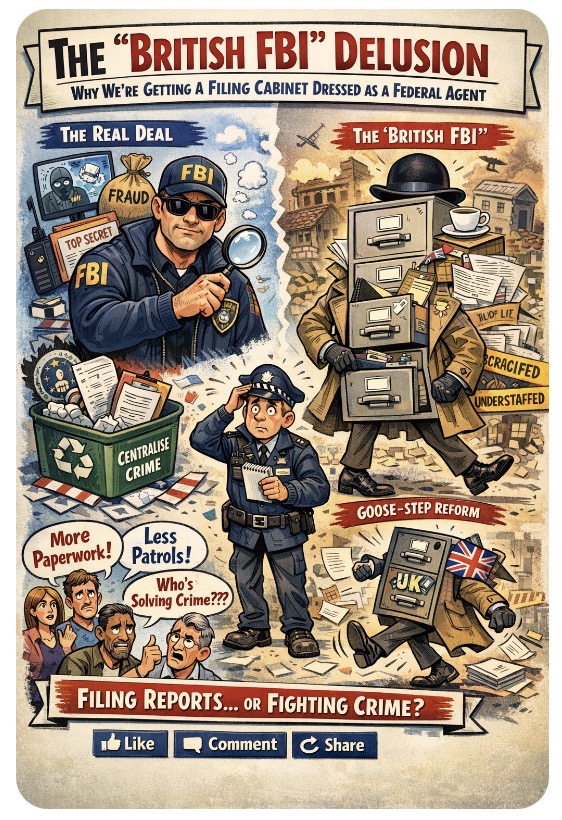
🕵️♂️🇬🇧The UK government’s shiny new law enforcement plan comes gift-wrapped in transatlantic cosplay: “a British FBI!” Sounds slick, sounds serious — but scratch the surface and all you’ll find is bureaucratic MDF where there should be a steel backbone. This isn’t law enforcement innovation. It’s just admin in a trench coat.
📎 When You Order the FBI from Wish.com
Let’s be clear: the FBI works because it’s boringly specific. It deals with long-haul spycraft, digital ghost-hunting, and federal fraud that leaps across state lines like a caffeinated hedge fund manager. It’s a scalpel, not a Swiss Army knife. And crucially, it does not do what your neighbourhood copper does — no patrolling, no sirens, no charming bobby-on-the-beat vibes.
Now, try squishing that model into Britain’s centralised, over-stretched, underfunded, Excel-addicted policing framework. You get… what, exactly? Another national agency that sounds impressive in a press release and achieves roughly the same as your office recycling bin: a brief feeling of virtue followed by crushing inefficiency. ♻️📉
Instead of fixing the real issues — burnout, bureaucracy, detective drain — the Home Office is playing dress-up. What they’re calling a British FBI is actually more of a centralised queue management system for crimes that already fall through the cracks. It won’t catch the crooks — but it might catalogue them before they vanish.
And here’s the kicker: in the U.S., the FBI avoids replacing local police. Meanwhile, in the UK, we’re marching in the opposite direction with the grace of a goose-stepping filing cabinet. Because nothing says “modern crime-fighting” like another layer of forms, flowcharts, and flowery press conferences.
🔥 Challenges 🔥
What crimes will this new “FBI” actually solve? Why are we pretending that repackaging the same problems in a shinier font counts as reform? And when did calling something cool become more important than making it work?


 Chameleon Magazine
Leave a comment