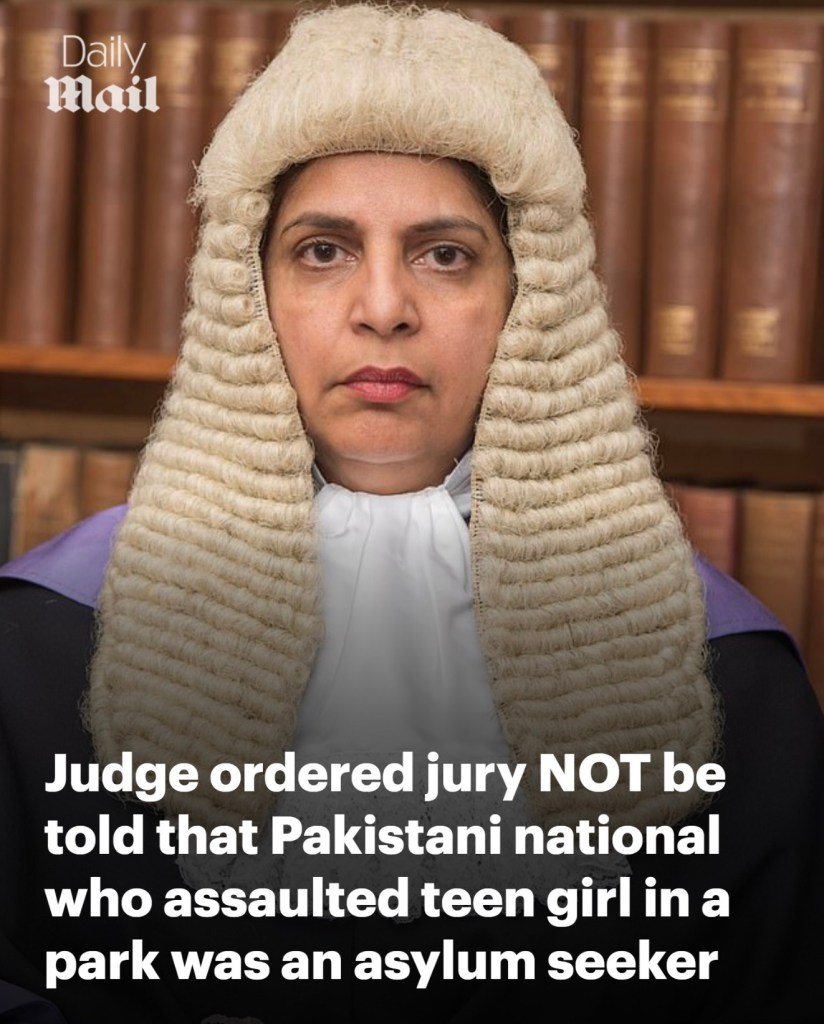
⚖️🔍In a UK courtroom last week, a Pakistani national stood trial for the assault of a teenage girl in a public park—an already harrowing case made more controversial by the judge’s instruction to the jury: you are not to be told the defendant is an asylum seeker.
This was not an accidental omission. It was a deliberate judicial decision to remove the man’s immigration status from the jury’s field of vision—a move justified, according to legal insiders, as necessary to preserve the defendant’s right to a “fair trial.” But for critics and legal reform advocates, this represents something far deeper: the steady erosion of transparency under the guise of impartiality.
The Gag Reflex of the Legal System
At the heart of this controversy lies an uncomfortable question: whose version of fairness is the British justice system serving? Because in this case, it’s certainly not the jury’s right to know the full truth. Nor is it the public’s right to understand how our immigration systems intersect with criminal proceedings.
The defendant’s asylum status, whether or not it influenced the crime, was considered “prejudicial.” But what does that term really mean anymore? Increasingly, it appears to mean politically inconvenient.
Imagine a world where a jury can hear about what a victim wore, where she walked, what time it was—but not that the perpetrator was in the country under specific legal protections or claiming sanctuary from another state. That world is not hypothetical. It’s where we are now.
Politics in the Dock
Let’s not pretend this is just about one judge, or one case. This is about systemic risk aversion: the judiciary’s fear of headlines, of public backlash, of being accused of feeding into anti-immigration sentiment.
So instead, they feed juries an edited version of reality—one that might be procedurally “clean,” but is contextually dishonest. The law, after all, is supposed to deal in facts. Not just the ones that pass a PR test.
There’s also the deeper issue of accountability. If someone abuses the asylum system, or commits a crime while protected by it, that’s not just a personal failing. It raises questions about vetting, about enforcement, about public safety versus humanitarian policy. But if no one is allowed to name the connection, how do we ever improve it?
Why This Matters
Ask yourself this: if the roles were reversed—if a native-born Briton committed the same crime—would any personal details be withheld for fear of “prejudice”? Doubtful. In fact, the opposite usually happens: criminal backgrounds, affiliations, previous charges—all laid bare.
So what we’re seeing isn’t neutrality. It’s asymmetry. One that protects institutions from criticism while keeping the public in the dark.
Transparency isn’t always comfortable. But justice without it isn’t justice—it’s management.


 Chameleon Magazine
Leave a comment