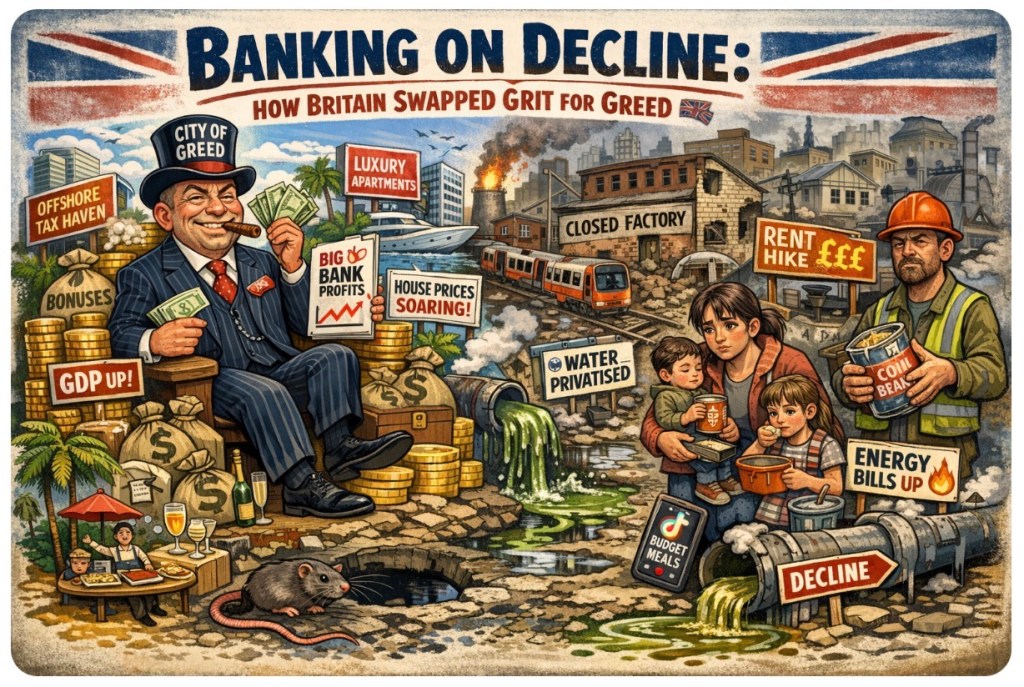
💷🏗️Once the engine room of industrial might, Britain now moonwalks backward — proudly holding spreadsheets instead of spanners. Welcome to the economy where making money from money replaced making anything at all.
💸 The Great Swap: From Steel to Stealing the Future
It started with a seemingly innocent trend: finance outpacing industry. Then came the real estate casino, the debt buffet, and the policymaker fan club for asset hoarders. Before you could say “manufacturing base,” Britain had outsourced its essentials, handed public infrastructure to hedge funds, and called it progress.
Banking, once the loyal butler to industry, staged a bloodless coup and became the king. It didn’t just grow — it devoured. Water? Owned by pension funds in Ontario. Rail? Run for shareholders in Berlin. Energy? Pray to the volatility gods and pay up.
But here’s the kicker: the worse things get, the better it looks — on paper. High GDP? Check. Soaring house prices? Check. Crumbling council estates, stagnant wages, and £6 sandwiches on a £9/hour wage? Also check.
Because the financialisation of everything doesn’t build; it harvests. It doesn’t repair; it repackages. It doesn’t plan; it delays — until the train derails, the water poisons you, and the heating bill eats your salary.
Migration is blamed. Poor planning is not. Wages don’t rise. Rent does. The working class doesn’t just fall behind — they are being asset-stripped while scrolling budget meal prep on TikTok.
And the rich? Don’t worry. Their capital is parked in offshore tax havens, and their domestic exposure ends at wine cellars and gated driveways.
No, Britain won’t collapse. It’ll just shrivel politely, explaining the “unforeseen market conditions” as kids go to school hungry and potholes get deeper than foreign policy.
🔥 Challenges 🔥
Do you see the rot, or just the polish? Have you noticed that the taps still run — but the pipes are cracked? That your train still arrives — eventually — but only if your wallet survives the fare? Comment on the blog, not just Facebook. Your voice isn’t a footnote — it’s a reckoning. 💥


 Chameleon Magazine
Leave a comment