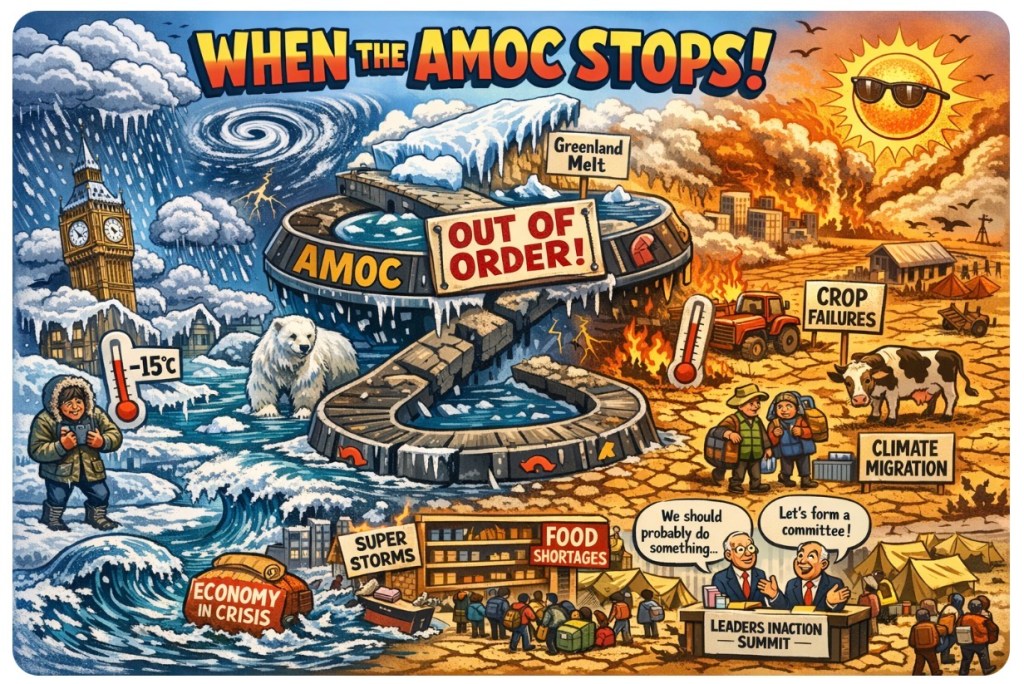
❄️🔥If the Atlantic Meridional Overturning Circulation (AMOC) — the great ocean conveyor belt — were to fail, we wouldn’t just be looking at rough seas. We’d be looking at civilisation-changing chaos. It’s the climate’s silent stabiliser, moving warm water north, cool water south, and holding weather systems in place like invisible scaffolding. Tear it down, and the world gets weird — fast.
🌀 The World Unravels, One Current at a Time
Imagine waking up in London to a -15°C winter, only to check the news and find Spain battling wildfires — in February. That’s not climate fiction. That’s what scientists believe could unfold if AMOC collapses.
Here’s what’s on the disaster menu:
- Northern and Western Europe freeze over 🧊
Without warm water flowing north, the UK and much of Europe would experience bitter, prolonged winters. Think “snow in April” and “frozen Thames” levels of cold. - Southern Europe scorches 🔥
As the jet stream warps, southern Europe could be hit with brutal droughts and unbearable heatwaves. Agriculture fails. Tourism tanks. Wildfires become seasonal events. - Tropical monsoons shift 🌧️
In South Asia and West Africa, essential rainfall patterns would weaken or disappear altogether, creating widespread droughts and food insecurity. - Atlantic hurricanes go berserk 🌀
With warm water trapped in the tropics, hurricane formation ramps up. The U.S. East Coast braces for more frequent, more intense, and less predictable storms. - Food systems and economies shake 🍽️📉
Global food production falters, energy grids groan under new pressures, and entire regions could become economically unsustainable. And this isn’t centuries off — it’s decades, possibly less, if tipping points are crossed. - Climate migration spikes 🧳🌍
If agriculture fails and extreme weather worsens, we could see tens of millions forced to relocate — not from war, but from weather.
🚨 Why This Matters
This isn’t a Hollywood collapse. It’s a slow-motion avalanche. And while the exact date is unknowable, the mechanism is clear: melting Greenland ice and increased rainfall dump freshwater into the North Atlantic, diluting the salty water that keeps the system running. If it loses momentum, we lose balance.


 Chameleon Magazine
Leave a comment