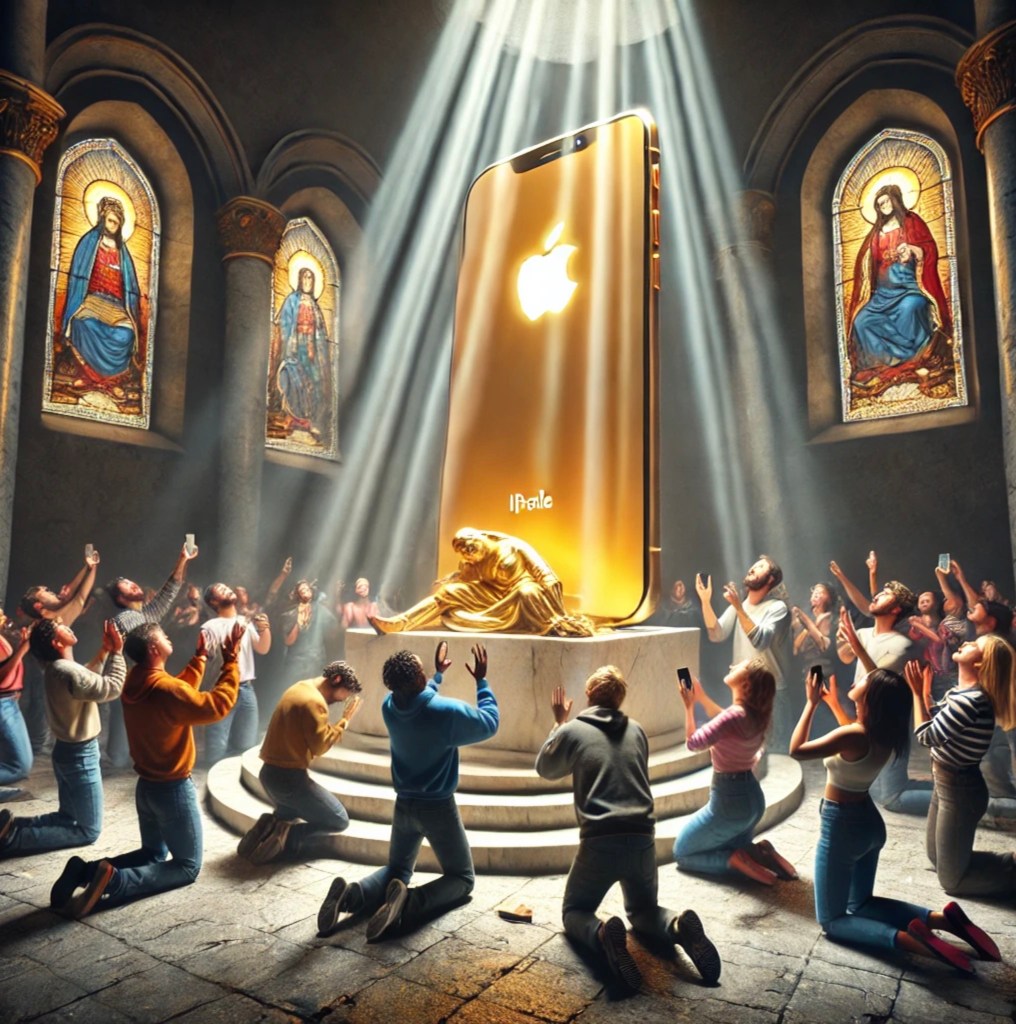
Once upon a time, civilisation knelt before holy books. Now it bows its head to a glowing rectangle that needs charging twice a day and cracks if you look at it funny. Behold: the modern scripture fits in your pocket, vibrates during sermons, and updates its commandments annually.
🔔 From Sacred Texts to Sacred Tech: Swipe to Believe
Let’s not dance around it. For millions of young people, Apple isn’t a brand—it’s a belief system. The iPhone isn’t a tool; it’s a totem. It tells you where to go, who to date, what to think, and when you’re insufficient unless you upgrade. 📲✨
Try banning it. Go on.
Try restricting access the way some governments restrict religion. The backlash would be biblical—ironically. Streets would fill faster than a midnight product launch. Hashtags would riot. Influencers would fast only until Wi‑Fi returned.
Religions once offered:
• Identity
• Community
• Moral guidance
• Ritual
Apple offers:
• Identity (green bubbles are heresy)
• Community (AirDrop communion)
• Moral guidance (“Your screen time is up” — ignored)
• Ritual (annual upgrade, kneel before keynote)
Coincidence? Or Cupertino canon? 🍏📖
And unlike ancient texts, this gospel updates. Features disappear. Chargers are sacrificed. The faithful accept it all without question. Try that with scripture and see how it goes.
What makes this truly powerful isn’t coercion—it’s consent. No morality police needed. The devotion is voluntary, joyful, and financed in instalments.
Governments can ban books.
They can restrict sermons.
They can regulate belief.
But touch the phone?
That’s when the real unrest begins. ⚡📵
Because this isn’t faith handed down.
It’s faith downloaded.
🔥 Challenges 🔥
If phones are the new scriptures, who writes the commandments—and who profits from your devotion? Are we witnessing the quiet replacement of belief with brand loyalty?


 Chameleon Magazine
Leave a comment