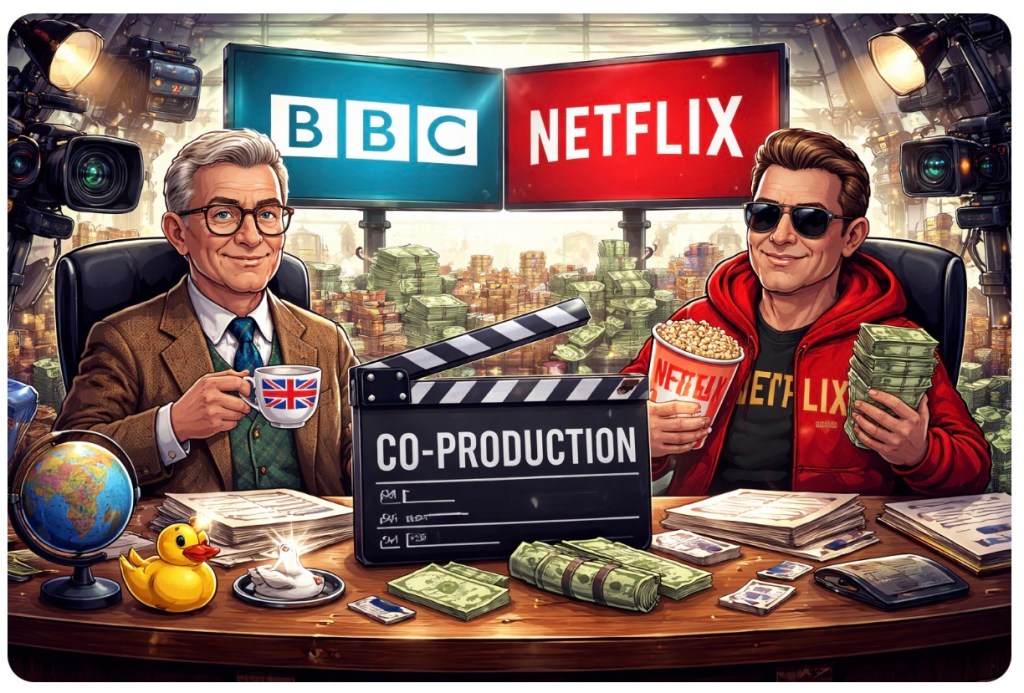
🎭🧨When a century-old public broadcaster tiptoes into bed with a Silicon Valley algorithm machine, you know something fishy—and deeply strategic—is afoot. This isn’t about sharing British period dramas over tea; it’s about survival, optics, and a quiet cultural colonisation wrapped in the language of “collaboration.”
🎬 When Auntie Becomes a Content Creator for Hire 🤝💸
On one side, we have the BBC—Britain’s tweed-wrapped oracle of public enlightenment, historically allergic to profit motives and guided by the noble principles of “inform, educate, entertain.” On the other, Netflix—a turbo-capitalist content bazooka, fuelled by churn rates and the sacred god of Watch Time.
So why the flirtation?
Because Netflix, despite swimming in billions, can’t algorithm its way to gravitas. And the BBC, crumbling under political pressure and Gen Z indifference, needs distribution clout and cash like a period drama needs candlelight.
Netflix gets to look like it cares about culture (💅), and the BBC gets a sugar daddy with global reach and the seductive powers of auto-play. It’s cultural outsourcing with a PR twist: “Look, we’re relevant! We’re global!”
But let’s not mistake this for a “partnership of equals.” That’s like calling an Uber ride a romantic journey.
Netflix wants what it can’t grow in a test lab—trust. The BBC wants what it can’t vote for—visibility. And both pretend this won’t end in some kind of identity crisis where David Attenborough documentaries roll out between “Love Is Blind: Leeds” and “Emily in Battersea.”
It’s less of a merger and more of a hostage negotiation conducted over tea and analytics dashboards.
And let’s talk about the content. You think the BBC’s quiet moral ambiguity survives the “Next Episode in 3…2…” countdown? Please. The algorithm doesn’t do nuance—it does click-throughs, cliffhangers, and “is this show trending in Malaysia yet?”
What we’re watching isn’t just a strategic media handshake. It’s the slow Airbnb-ification of the public sphere. Rent out your trust. Lease your values. Hope no one notices the foundations are cracking. 📉🕳️
So sure, let them “co-produce.” Just don’t be surprised when the BBC’s mission gets gently reshaped into a brand guideline.
Because culture, dear reader, is not just what we create. It’s who owns the platform.
Do you trust this “collaboration”? Or are we sleepwalking into a streaming-soaked future where even our public broadcasters start wearing hoodies and pitching shows to shareholders?


 Chameleon Magazine
Leave a comment