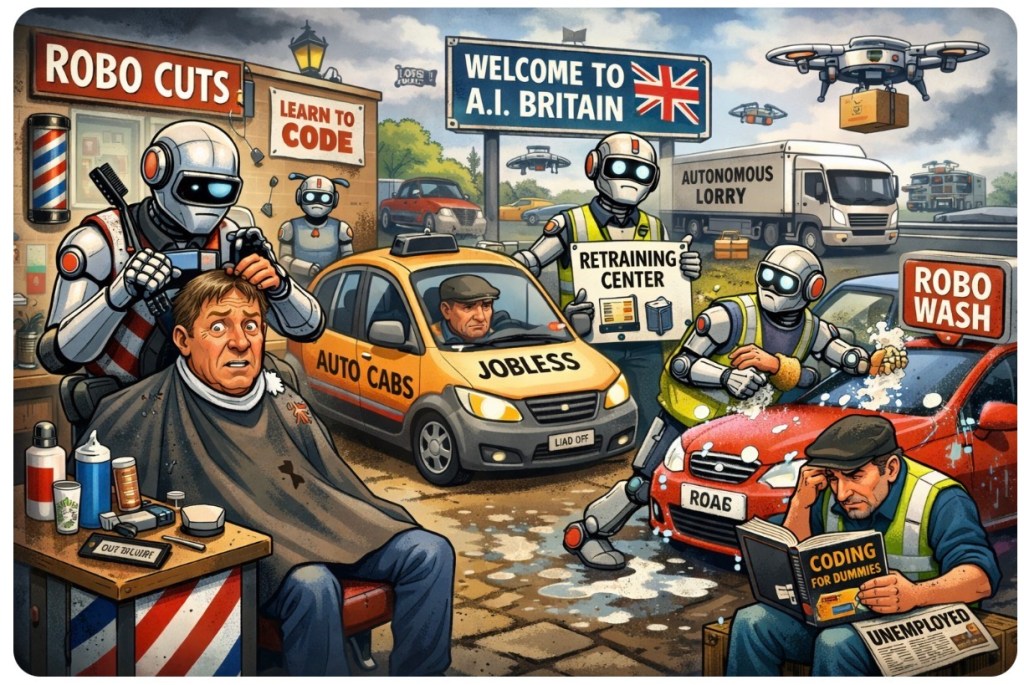
🤖🚗Britain’s roads are about to get a whole lot smoother—and a whole lot emptier. Not of traffic (don’t be silly), but of people. The rise of driverless cars is barreling toward us like a Tesla on caffeine, and it’s bringing redundancy slips in the glovebox. Up to one million UK jobs could be on the chopping block, from HGV heroes to Uber lifesavers. And don’t think it ends there—if these tin cans with Wi-Fi learn to hold scissors or a sponge, everyone’s side hustle is doomed.
💇♂️ When the Car Wash Talks Back and Gives You a Haircut
Let’s just say it: Britain’s human workforce is two “software updates” away from being a quaint little memory. First, they came for the truckers. Then the taxi drivers. Next? Your local barber gets replaced by a hydraulically-armed Skynet Salon™, and the guy at the hand car wash is just a damp QR code taped to a wall.
“Oh, just learn to code,” they’ll say, as if everyone with a steering wheel also dreams of debugging Java at 2AM. Pretty soon, the most secure job in Britain will be robot therapist—because these AI systems are going to need someone to talk to after absorbing 400 years of British road rage in a week.
And let’s be honest: do you trust a driverless car to get you from Glasgow to Cardiff without deciding halfway through to become a crypto influencer and steer into the Irish Sea? Meanwhile, governments are busy “retraining” people with PDFs and webinars while the actual economy gets drag-and-dropped into the recycling bin.
Let this sink in: we created machines so efficient, they made us obsolete in the time it takes to drink a service station coffee. ☕🤖
⚠️ Challenges ⚠️
Who exactly decided human relevance was optional? Who benefits when machines do everything but pay rent or buy dinner? Drop your outrage, your sarcasm, your most unhinged anti-AI haiku in the blog comments. 💥🔥


 Chameleon Magazine
Leave a comment