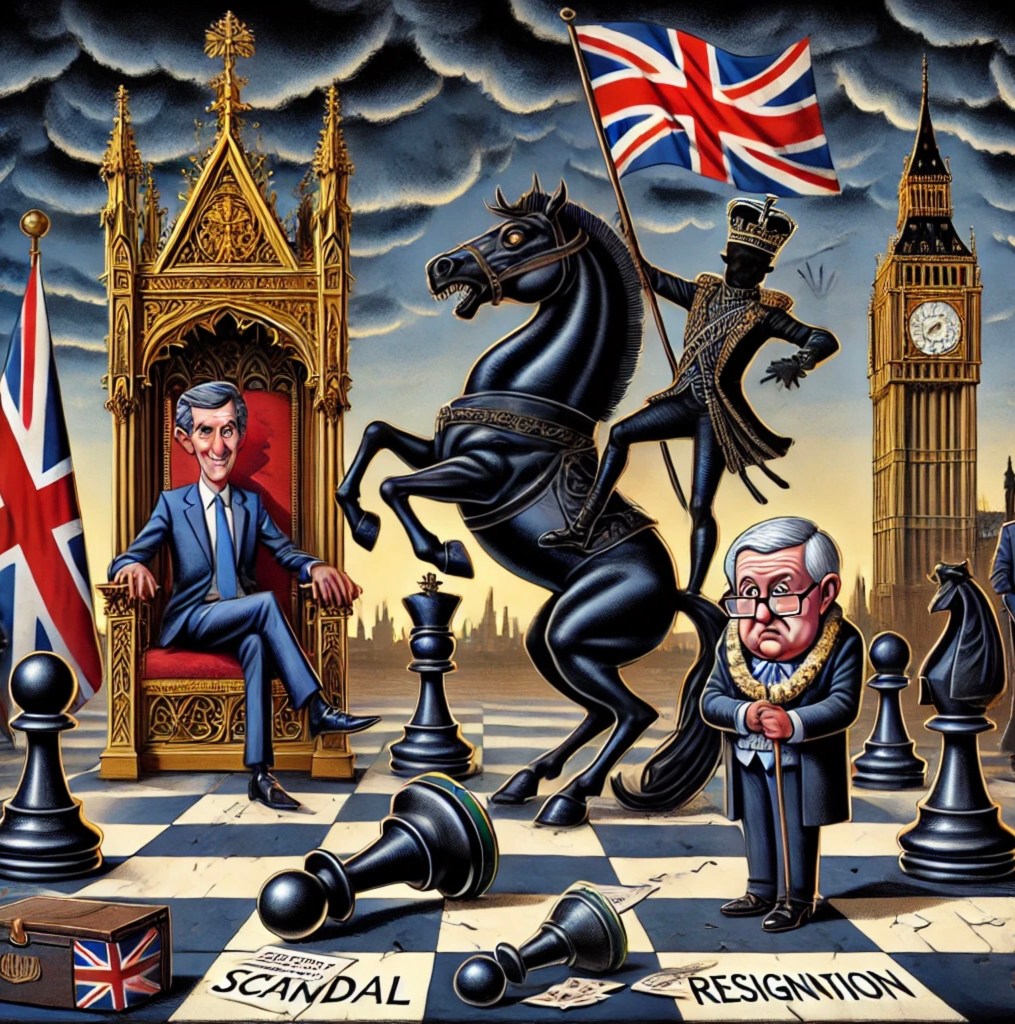
👑🚫British politics isn’t a debate—it’s a bloodless chess game where the Prime Minister never leaves the back row, and the pawns are real people with careers, reputations, and unfortunate proximity to scandal.
♜ Sacrifice the Bishop, Save the Throne
Another advisor falls. Another Prime Minister survives. And if it’s all feeling a bit too choreographed, that’s because it is. We’re not watching governance—we’re watching damage control in 64 squares.
Morgan McSweeney resigns. The crowd murmurs. The PM tips his head, solemnly “accepting” the move like a grandmaster reluctantly giving up a knight he never liked anyway.
Don’t be fooled by the solemn expressions and regretful tweets. This isn’t remorse—it’s strategy.
Because advisors? They’re expendable pieces, moved just far enough forward to absorb a scandal, then politely removed when the blowback gets too close to the Queen’s Gambit.
The Prime Minister, meanwhile, remains untouched, robed in executive immunity, fingers steepled like a Bond villain mid-podcast. “Mistakes were made,” they say—always passive, always abstract—like the scandal floated in on a fog.
No. The moves were made.
By the person at the top of the board.
🧠 Let’s Talk Rules
Aides advise.
Civil servants support.
Spads spin.
But only the Prime Minister moves the kingdom. Only the PM sees the board. And only the PM has the power to slam the metaphorical clock and say: This is the way.
When bad decisions detonate, it shouldn’t be the pawn who gets blamed for stepping where they were told. But British politics has flipped the rules:
– Power is cloaked.
– Blame is outsourced.
– And accountability? That’s the piece they “accidentally” dropped under the table.
A Prime Minister will castle behind an aide faster than you can say, “constitutional responsibility,” and when the public fury flares up, out goes the sacrificial rook.
“We’ve accepted their resignation.”
Translation: Our flank was exposed. We’ve corrected it. Please return to apathy.
🎭 The Illusion of Accountability
Let’s be clear: no PM accidentally ends up behind a wall of fallen advisors. It’s not bad luck—it’s design. It’s a strategy carved from the cold logic of chess:
- Take the heat.
- Dump a piece.
- Reset the board.
And we? We’re left clapping for another elegant resignation while the one who moved the piece wipes down the board and says, “Lessons will be learned.”
Spoiler: they never are.
♞ Challenges ♞
How long will we watch this rigged game and pretend it’s democracy? When will we demand the King take responsibility for the moves he made, instead of applauding every time a knight gets kicked off the board?


 Chameleon Magazine
Leave a comment