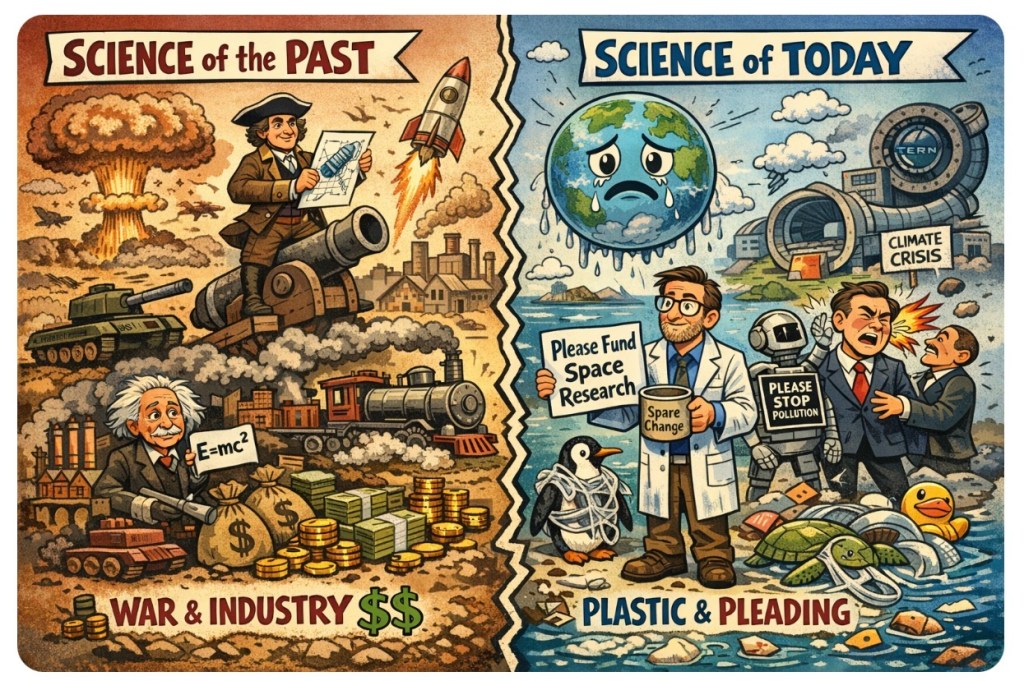
Once upon a time, science didn’t ask for spare change — it took it, powered by muskets, smokestacks, and the occasional empire with a god complex. From the cannonball trajectory of Newton’s laws to the steam-fueled frenzy of the Industrial Revolution, science got its funding not by whining into the void, but by strapping on boots and striding into relevance. Now? It’s passed the hat around while microplastics choke whales and quantum computing conferences are hosted in beige hotel rooms with stale muffins.
💣 From Muskets to Microchips: Science Used to Come With a Bang, Not a Whimper
Let’s get this straight: the universe is very cool. Black holes, dark matter, particles that act like cats in boxes — all good stuff. But historically, the money for that kind of research didn’t come from wistful speeches or inspirational TED talks. It came from war or the desperate need to out-build the competition. Science was a byproduct of national obsession, not a side hustle with a Patreon.
World War II? We got radar, rockets, and, uh, some ethically dubious bombs. The Cold War? Satellites, space race, internet foundations. And the Industrial Revolution? Basically the blueprint for every STEM field today — all thanks to profit-hungry factories belching coal like they were gunning for a climate crisis.
Today, in contrast, science holds out a tin cup while the seas fill with plastic and species disappear faster than the UK’s R&D budget. “Please sir, may I have some more… neutrino funding?”
How about no, say the public — “Not until my tap water stops tasting like regret and seaweed.”
Maybe it’s time to admit that pure discovery doesn’t pay like it used to. Science needs to earn its place again — not just by unlocking cosmic secrets, but by solving tangible nightmares.
Like unplasticing the oceans.
Or unboiling the atmosphere.
Or inventing a robot that slaps world leaders every time they say “net zero by 2050.”
It’s not about abandoning curiosity. It’s about earning relevance, not demanding reverence.
🧠 Challenges 🧠
Should science serve humanity before it serves the stars? Is it time to redirect funding from particle accelerators to plastic annihilators? Or are we just short-sighted bean counters with no sense of wonder? Drop your hottest takes in the blog comments — we’re watching. 👀🔥
👇 Click comment, click like, click share. Let’s bring back useful science with teeth, not just stars in its eyes.
Top comments will get featured in our next magazine issue — because you, dear reader, are the real peer review. 🧪💬


 Chameleon Magazine
Leave a comment