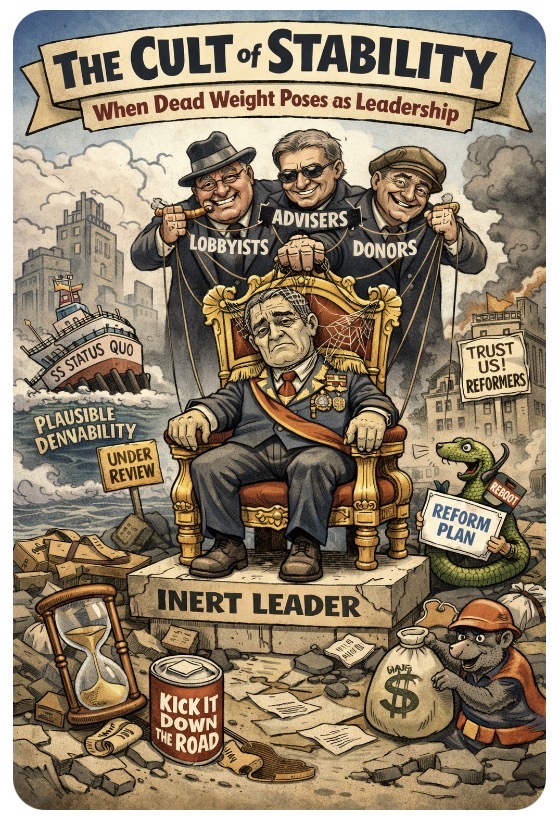
What looks like calm governance is often just rot in a velvet robe. “Stability” has become the political safe word for regimes that are neither stable nor remotely awake at the wheel — just too bloated, entangled, and image-obsessed to collapse quickly.
🧊 The Fine Art of Inert Leadership (a.k.a. Doing Nothing, Loudly)
Let’s be honest — when a politician starts bleating about “stability,” what they usually mean is “please don’t look too closely.” It’s not leadership. It’s not strategy. It’s furniture — ornate, creaky, and too fragile to move without causing a mess. 🪞
These leaders aren’t steering the ship. They are the figurehead — bolted to the bow while the real captains (lobbyists, donors, unelected “advisers,” and assorted spreadsheet goblins) quietly drag the vessel into a fogbank of plausible deniability.
The genius of the system? Make the ornamental leader take all the public flak. Meanwhile, the true power holders — faceless and frictionless — slide policy through side doors and exit clauses.
By the time the public realises there’s no one actually home, it’s too late. The language has been neutralised (“stability”), the outrage redirected (“at least they’re not the other side”), and the accountability outsourced to “ongoing reviews.”
And when the house finally caves in?
The same crew that hollowed it out will reappear — as “reformers.” 🛠️🐍
Because in these systems, rot isn’t failure.
It’s tradition.
🔥 Challenges 🔥
How long are we going to pretend inertia is competence? That hollowed-out leadership is a price worth paying for “not rocking the boat”? If your patience has an expiry date, slap it in the comments and tell us how long is too long to wait for something real. ⏳👀


 Chameleon Magazine
Leave a comment