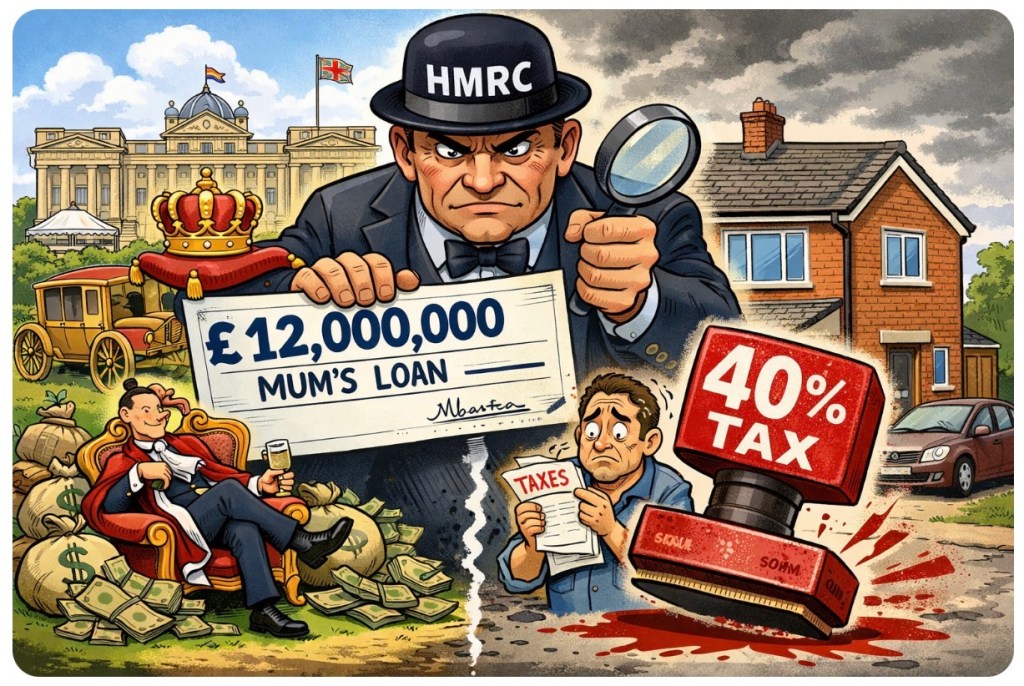
💷👑💥Strip away the tiaras. Remove the velvet ropes. Cancel the carriage.
If your mum wires you £12 million to “sort something out” — and then dies — congratulations. You’ve just enrolled in the most unglamorous masterclass the UK offers: HMRC vs. Wishful Thinking.
Let’s explore what happens when you don’t have a crown in the family photo. 📸
💼 HMRC Doesn’t Care About Your Feelings (Or Your Family Drama)
Under ordinary UK law, a £12m “loan” from mother to son is not some sentimental gesture wrapped in lace and nostalgia. It’s either:
- A real, legally repayable loan
- A gift disguised as a loan
- A loan quietly forgiven before death
And HMRC will politely — but firmly — ask: “Which is it?”
If it’s a real loan and still unpaid at death?
It sits in the estate like a big, taxable elephant. 🐘
It increases the estate value.
It does not evaporate.
If it was forgiven within seven years?
Boom. 💣
Potential 40% Inheritance Tax exposure.
£12,000,000 × 40% = £4.8 million
There’s no “But he’s my son!” exemption. Family loyalty is not a tax code.
📜 Documentation: The Most Boring Thing That Can Ruin You
No repayment schedule?
No interest?
No enforcement?
HMRC may decide it was a gift from the start.
And once we’re in gift territory, the 7-year rule comes knocking like an auditor with a clipboard and zero patience. 📋
Survive seven years? Fine.
Die within seven years? Potentially very expensive grief.
Intent matters. Paperwork matters. “But we understood each other” does not matter.
🏛️ Now Enter the Royal Plot Twist
When discussing high-profile cases involving figures like Prince Andrew and the late Queen Elizabeth II, something interesting happens.
The public does not see:
- Detailed estate breakdowns
- Loan agreements
- Repayment confirmations
- Write-offs
- Probate schedules
For ordinary families? Probate is public. Estate values are visible. Assets are itemised.
For monarch-to-monarch transfers? There exists a long-standing constitutional exemption from Inheritance Tax — an arrangement not available to anyone who shops at Tesco and files self-assessment returns like the rest of us.
Legally, the tax code is written one way.
Structurally, transparency is not distributed equally. 👀
🧾 The Brutal Arithmetic of Being Ordinary
If your mum gives you £12m:
- If it’s a loan → it’s an estate asset.
- If it’s forgiven → 7-year rule applies.
- If she dies inside that window → up to 40% tax.
- Probate? Public.
- Scrutiny? Standard.
No sealed documents.
No constitutional cushions.
No velvet exemption clause.
Just spreadsheets. 📊
🔥 Challenges 🔥
Here’s the uncomfortable question:
Is the law truly equal if transparency isn’t?
Does constitutional tradition justify tax opacity? Or should large financial movements — royal or otherwise — face identical sunlight? ☀️
Drop your view in the blog comments (not just social media). Disagree. Defend. Dissect. But make it sharp.
👇 Comment. Like. Share.
The best arguments — savage or surgical — will be featured in the next issue of the magazine. 📝🔥


 Chameleon Magazine
Leave a comment