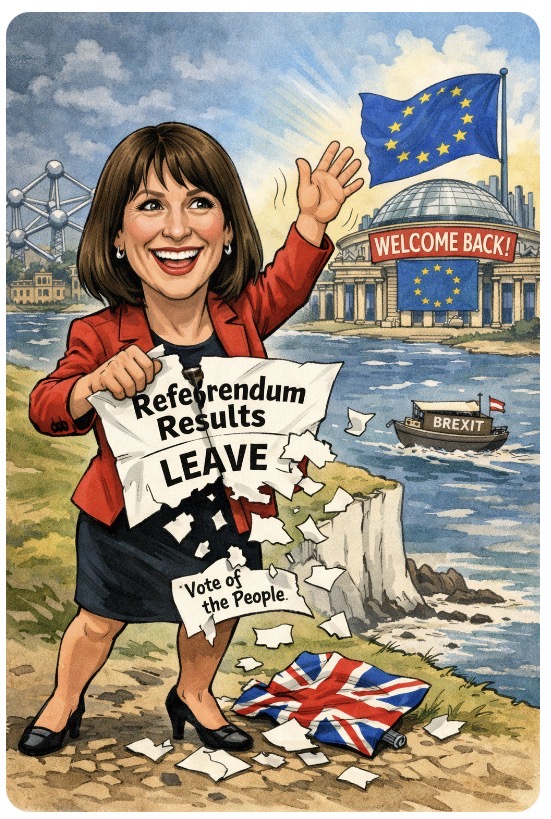
Rachel Reeves has made her pitch crystal clear: Britain’s future is “inextricably bound” to Europe. Closer trade ties, regulatory alignment, security cooperation—the whole continental package. The question hanging in the air like a stubborn fog over Dover? Is this a pragmatic reset… or a velvet-gloved rewind of Brexit itself? 🎭
🧾 “Sovereignty, But Make It Negotiable”
Let’s decode the subtext. Reeves argues that tighter alignment with the European Union is about growth, resilience, defence—grown-up stuff. She wants fewer trade barriers, smoother exports, less red tape strangling UK businesses. Sounds sensible, right?
But here’s where it gets spicy 🌶️
Brussels rarely offers a free lunch. Alignment often means adopting EU standards, rules, and—critics warn—accepting oversight mechanisms that look suspiciously like power-sharing. Then there’s the “Made in Europe” strategy, youth mobility proposals, and the subtle implication that access comes with conditions attached.
In trade negotiations, nations don’t do sentiment—they do leverage. And if Britain aligns too closely, some argue it risks paying twice: once in regulatory flexibility, and again in financial contributions or concessions.
Cue the sovereignty sirens 🚨
Supporters call this realism. Britain trades heavily with Europe; geography isn’t going anywhere. Critics call it creeping reversal—Brexit in name, Brussels in practice. They ask: if we’re aligning standards, accepting mobility schemes, and syncing strategies, what exactly did we leave?
And hovering across the Atlantic is the United States, negotiating its own enhanced trade relationship. Washington may not cheer if London drifts too far back toward EU orbit. 🌎
Meanwhile, voters—remember them?—were promised that Brexit meant control. Now the political tightrope is whether “control” can coexist with deep integration. Because let’s be honest: sovereignty sounds magnificent in a speech, but frictionless trade sounds magnificent on a balance sheet. 📊
So is this economic pragmatism? Or political amnesia?
🔥 Challenges 🔥
Here’s the uncomfortable question: If closer alignment boosts growth but trims sovereignty, what matters more to you? 💭
Is Brexit a fixed doctrine—or a flexible tool?
Should there be a referendum before any major shift?
Or is governing about adapting to reality, not replaying 2016?
Don’t just rage-scroll—drop your verdict in the blog comments. Stir the pot. Challenge the tribe. 💬🔥
👇 Like it. Share it. Comment on the site (not just social media).
The sharpest takes will be featured in the next issue of the magazine. 📰✨


 Chameleon Magazine
Leave a comment