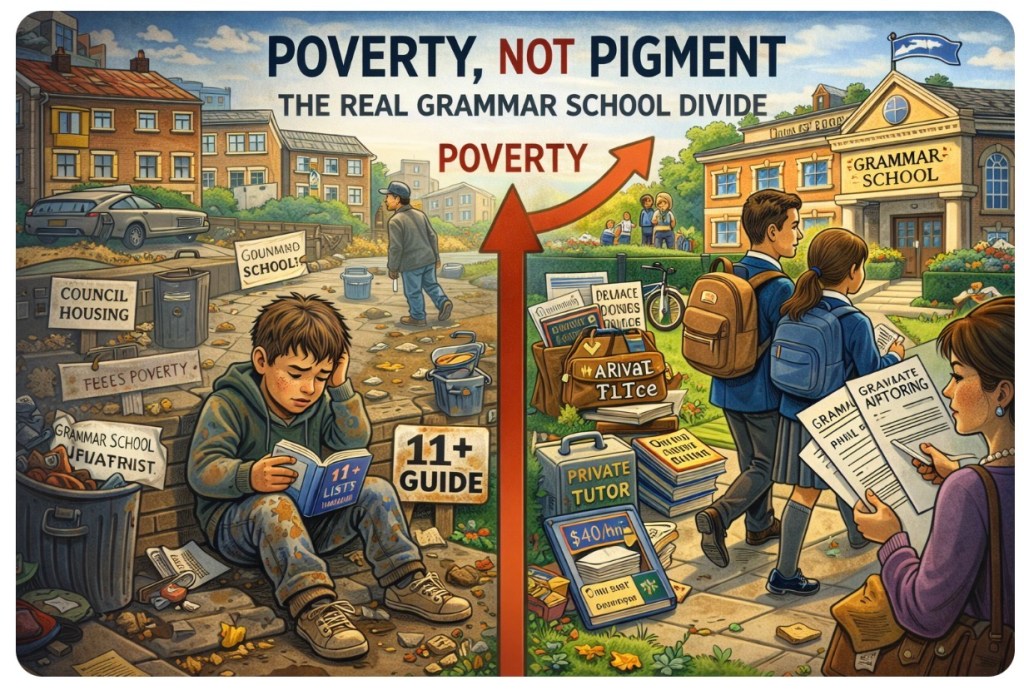
🎓🔥The latest headline would have you believe there’s a grand cultural plot unfolding in Britain’s classrooms. Young white boys, we’re told, are being squeezed out of grammar schools. It sounds explosive. It sounds intentional. It sounds like decline wrapped in injustice.
But here’s the uncomfortable truth: the real divide isn’t racial. It’s economic. And that’s a far less convenient villain.
Because blaming poverty doesn’t generate clicks. Blaming culture does.
🧠 The Exam That Selects Wallets, Not Skin
Let’s strip away the theatre.
Grammar school entry hinges on the 11+ — a competitive exam that has quietly become an arms race. And what wins arms races? Resources.
- Private tutoring (often years of it)
- Parents who understand the admissions maze
- Stable housing near catchment areas
- Time, confidence, and educational support at home
If you’re a low-income family — white, Black, Asian, or anything else — you are statistically less likely to access those advantages.
White working-class boys do struggle in national attainment data. That’s real. That’s documented. That’s serious.
But the cause isn’t “they’re white.”
The cause is “they’re poor.”
And poverty doesn’t care what colour you are.
💸 Selective Education Was Never Neutral
Grammar schools were designed to reward academic performance.
But in practice, they reward preparation.
And preparation costs money.
When middle-class families — across multiple ethnic backgrounds — invest in tutoring and strategic planning, they increase their odds.
Meanwhile, working-class children, including white boys in post-industrial towns, face:
- Underfunded local schools
- Lower household incomes
- Fewer academic role models
- Reduced access to extracurricular enrichment
That’s structural disadvantage. Not a racial conspiracy.
🎭 Why the Headline Hits Hard
“White Boys Left Behind” triggers cultural anxiety.
It suggests displacement.
It implies bias.
It ignites comment sections.
But “Selective Education Amplifies Class Inequality” doesn’t exactly set social media on fire, does it? 🔥
The real story is slower, messier, and less sensational:
Selective systems consistently underrepresent low-income pupils.
Full stop.
When you zoom in on white working-class boys, you’re highlighting one group within a wider class divide — not exposing a targeted exclusion policy.
⚖️ The Issue That Actually Deserves Attention
If poorer white boys are underperforming — and evidence suggests many are — that should concern everyone.
But the solution isn’t cultural blame.
It’s economic intervention.
- Early-years support
- Investment in struggling regions
- Reform of the tutoring-driven admissions model
- Or a broader rethink of selective education entirely
Because if grammar schools disproportionately benefit the prepared and the resourced, the question isn’t “who is being replaced?”
It’s “who can afford to compete?”
And that’s a much harder conversation to monetise.
🔥 Challenges 🔥
Is this really about race — or are we watching poverty dressed up as identity politics?
Are selective schools engines of opportunity… or mirrors reflecting Britain’s widening class divide?


 Chameleon Magazine
Leave a comment