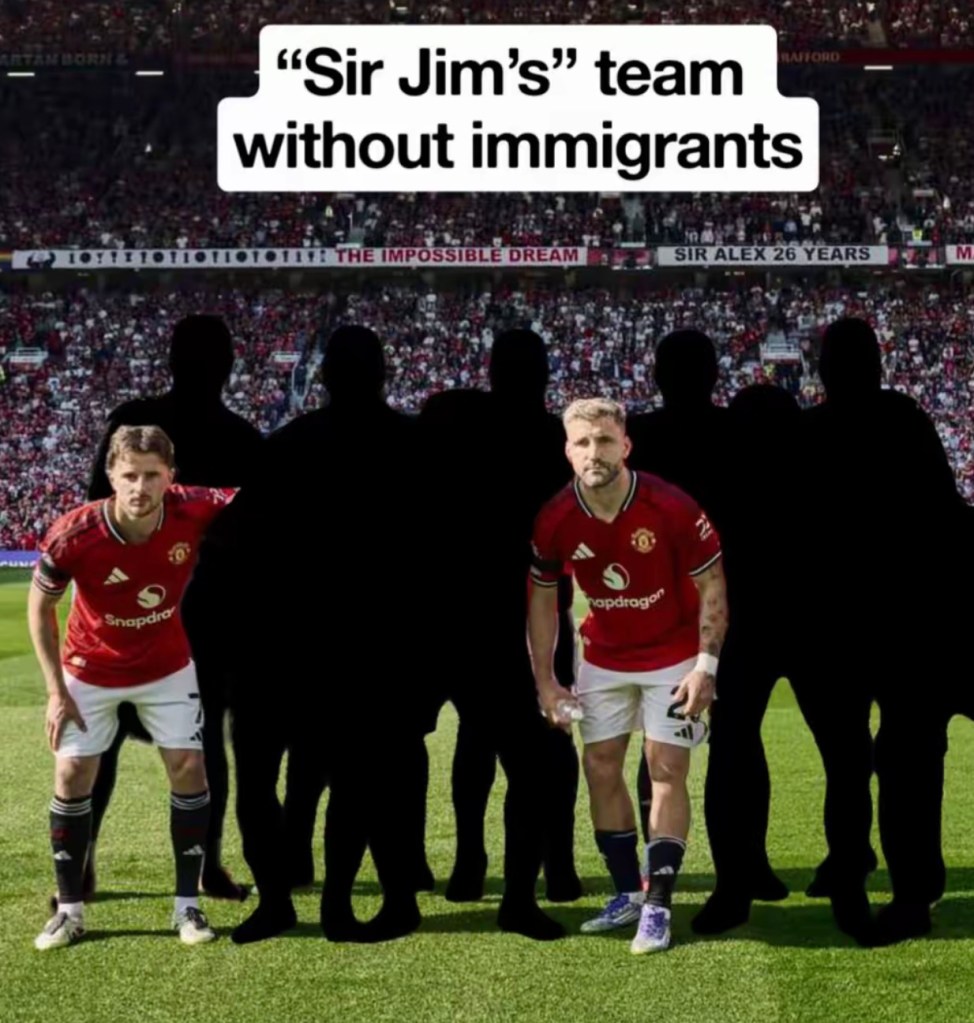
⚽💷A viral image does the rounds. A football team stands on the pitch. Most of the players are blacked out. The caption claims: “This is what the team would look like without immigration.”
Predictably, the comment section explodes. One side celebrates diversity. The other side fumes. Everyone argues about borders.
But what if that’s the wrong argument entirely? 🤔
🎯 The Narrative Was Too Easy
The image was quickly used to promote a pro-immigration message — framing modern football success as proof that open borders equal victory.
It’s neat. It’s punchy. It’s divisive.
And it may miss the deeper issue completely.
Because if a top English club relies heavily on overseas talent, that doesn’t automatically prove immigration is the hero of the story.
It might also suggest something uncomfortable:
Why aren’t we producing enough elite domestic players in the first place?
That question isn’t about nationality.
It’s about infrastructure.
🏟️ Grassroots vs Global Market
The Premier League is the richest football league on Earth. Broadcasting deals are astronomical. Sponsorship revenue is global.
Yet talk to local coaches across the UK and you’ll hear a different story:
- Crumbling pitches
- Volunteer-run youth clubs
- Limited access to facilities
- Parents fundraising for basic kit
Elite clubs can buy ready-made international stars. It’s faster. It’s proven. It wins trophies.
But grassroots development? That’s slower. Less glamorous. Less headline-worthy.
And often underfunded.
If domestic pathways were robust across the country — if school sports were better supported, if local academies had stable funding, if coaching was systematically invested in — the pipeline of British talent might look very different.
Instead, we rely on the global transfer market.
Not because British kids lack ability.
But because the system doesn’t consistently nurture it.
💸 Underfunding Isn’t Unique to Football
This isn’t just about sport.
Across the country we see similar patterns:
- Youth services cut
- Community centres closed
- School budgets stretched
- Local authority funding squeezed
When domestic infrastructure weakens, gaps appear. And those gaps get filled — by private investment, by international markets, by whoever can step in fastest.
The meme frames immigration as the defining factor.
But the alternative reading is far less tribal and far more structural:
Maybe we’ve simply stopped investing properly in our own foundations.
⚖️ The Real Conversation
Instead of arguing over who should or shouldn’t be on the pitch, perhaps the bigger question is:
Why is one of the wealthiest sporting ecosystems in the world not reinvesting enough into the communities that feed it?
If young British players aren’t progressing at the scale people expect, that’s not a cultural failure.
It’s a funding decision.
And funding decisions reflect priorities.
Because in the end, talent is universal.
Opportunity is not.
Maybe instead of using football as a proxy war for immigration debates, we should use it as a mirror — reflecting how national investment choices shape outcomes.
Less shouting about who arrived.
More scrutiny about where the money went.
That’s a far more interesting match to watch. ⚽🔥


 Chameleon Magazine
Leave a comment