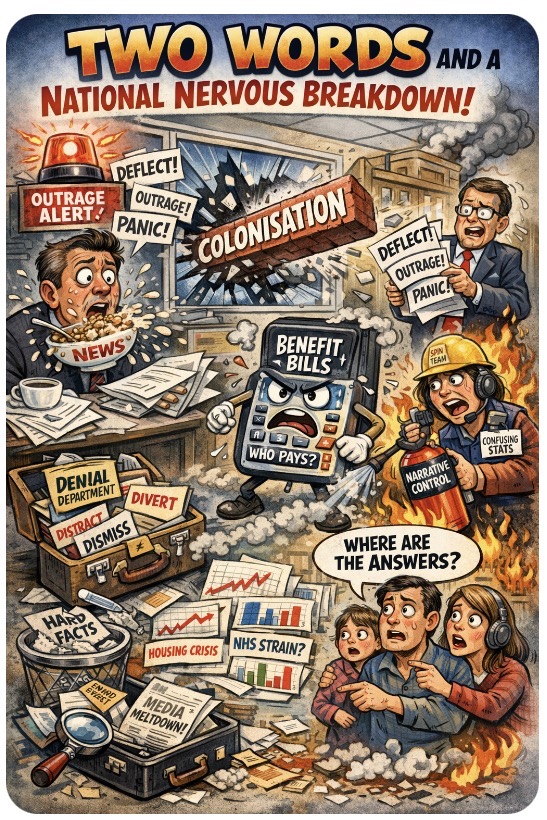
💣📰It takes a decade to draft a white paper, three committees to water it down, and one brave soul to utter two forbidden words to send the entire media ecosystem into cardiac arrest.
“Colonisation.”
“Benefit bills.”
Cue the emergency outrage sirens. 🚨🥣
Apparently, modern political discourse can survive scandals, U-turns, budget black holes, and vanishing pledges — but it cannot survive vocabulary.
🎭 The Great Linguistic Panic
Let’s be honest: this isn’t about grammar. It’s about gravity.
“Migration flows” sounds like a PowerPoint slide with pastel arrows.
“Net inflows” sounds like a spreadsheet.
“Population adjustments” sounds like someone moving chairs around a conference table.
But “colonisation”? That lands like a brick through a newsroom window. 🧱
Not because it’s polite.
Not because it’s universally accepted.
But because it implies something bigger than management. It implies permanence. Scale. Transformation.
And then there’s “benefit bills.” 💷
Those two words are even more dangerous. They don’t debate morality. They demand arithmetic.
Who pays?
How much?
For how long?
That’s not inflammatory. That’s accounting.
And nothing disrupts a carefully managed narrative faster than a calculator. 🧮
The real panic isn’t about compassion versus cruelty. It’s about control versus clarity. When discussions shift from slogans to sustainability, the temperature rises — because numbers don’t applaud speeches.
A curious thing happens when voters start asking:
- What’s the net fiscal impact?
- Can housing supply keep pace?
- Is infrastructure scaling?
- Are public services absorbing demand?
Suddenly, talking heads reach for adjectives instead of answers.
Outrage becomes the shield.
Condemnation becomes the substitute for explanation.
And the louder the reaction, the more obvious the pressure point. 🎯
A mature democracy should be able to withstand strong language. You can dispute terminology. You can argue nuance. You can present counter-data.
But if two words cause a meltdown, perhaps the issue isn’t rhetorical extremism — perhaps it’s narrative fragility.
Strong societies don’t faint at vocabulary.
They respond with evidence.
If policies are sustainable, demonstrate it.
If systems are resilient, prove it.
If integration is working, show the metrics.
Otherwise, the cereal keeps getting spluttered. 🥄🔥
🔥 Challenges 🔥
Be honest — did those words trigger you, or did the reaction to them?
Is outrage protecting the public… or protecting the storyline? Drop your sharpest take in the blog comments — not just a quick scroll-by reaction. Tell us where the real discomfort lies. 💬⚡
👇 Like it. Share it. Argue with it.
The boldest, smartest, and most incisive comments will be featured in the next issue of the magazine. 📝🏆


 Chameleon Magazine
Leave a comment