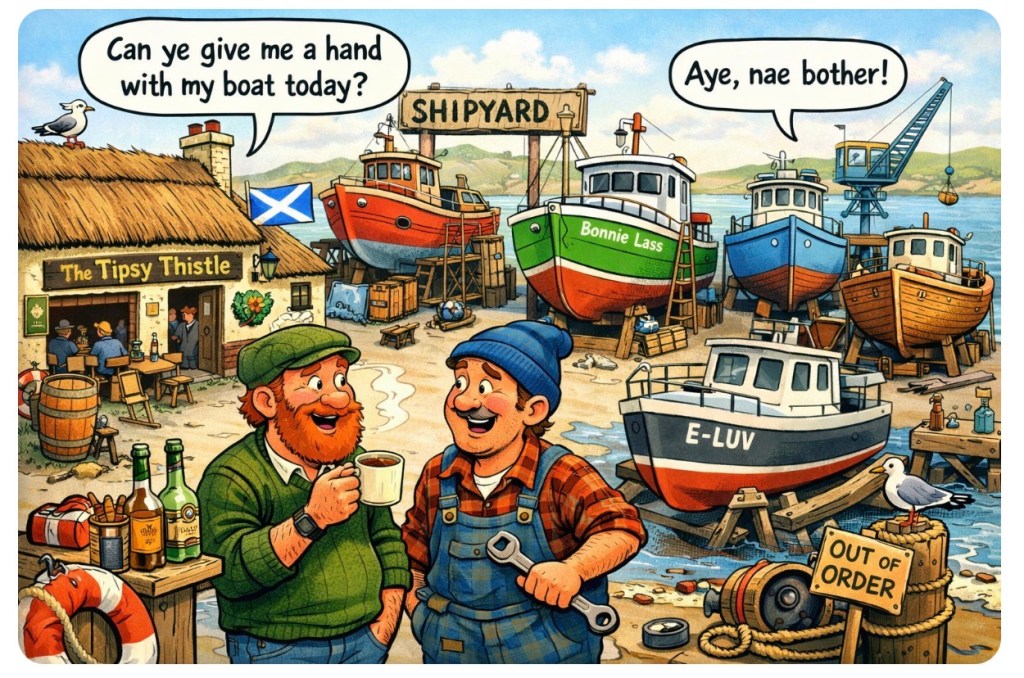
🥃🚢On the windswept shores of the Isle of Lewis, a bold industrial revival was born. Not in a Westminster committee room. Not in a boardroom with graphs and laser pointers. But — if we’re honest — probably somewhere between the third dram and the fourth “aye, we could do that.” 🍻
Coastal Workboats Scotland Limited entered administration this week, leaving five workers redundant and five boats unfinished. The company had secured £6.2 million in UK Government funding, £167,000 from Highlands and Islands Enterprise, plus £1.6 million in unsecured backing from Damen Hardinxveld — all to revive shipbuilding in Stornoway for the first time in a century.
Which just proves: nothing says “measured industrial strategy” like “hold my whisky.” 🥃
🍺 The Pub Pitch That Rocked the Hebrides
Picture it. The only pub on the island. Fire roaring. Rain horizontal.
“Ye ken what this island needs?”
“A ferry?”
“Naw.”
“A chippy that stays open past eight?”
“Naw.”
“A fully electric commercial workboat shipyard revival backed by multi-million pound public investment?”
“…Aye. That’s the one.” ⚡🚤
And just like that — somewhere between a packet of dry roasted peanuts and a round of Laphroaig — a century of dormant shipbuilding history was reawakened.
To be clear: these were real boats. Real steel. Real contracts. Including work toward the UK’s first fully electric commercial workboat. Not tiny schooners in decorative bottles. Though, in hindsight, the bottles might’ve been easier to finish.
The problem? Modern shipbuilding is not something you casually assemble like a shed from B&Q. It requires scale, supply chains, engineering depth, and cashflow buffers thick enough to survive delays. Instead, we had five workers building five vessels — which sounds less like an industrial strategy and more like the world’s most expensive group project.
And when design challenges and supply chain delays arrived — as they do — the whisky-fuelled optimism met the cold Atlantic reality. 🌊
Administrators from FRP Advisory are now sorting claims, while agencies including Highlands and Islands Enterprise and the Stornoway Port Authority ponder what’s salvageable.
Somewhere, in that same pub, there’s probably already a new idea brewing.
“Hydrogen-powered submarines next?”
“Aye, why not.” 🛳️
🔥 Challenges 🔥
Was this bold Hebridean ambition tragically scuppered — or the most expensive pub brainstorm in Scottish history?
Does rural industry need this kind of daring energy? Or does someone need to water down the whisky before the next economic strategy session?
Take it to the blog comments — not just Facebook. 💬🔥
Would you have backed the dream? Or ordered another round and suggested starting smaller… like kayaks?
👇 Comment. Like. Share.
The best (and funniest) responses will be featured in the next issue of the magazine. 📰🥃


 Chameleon Magazine
Leave a comment