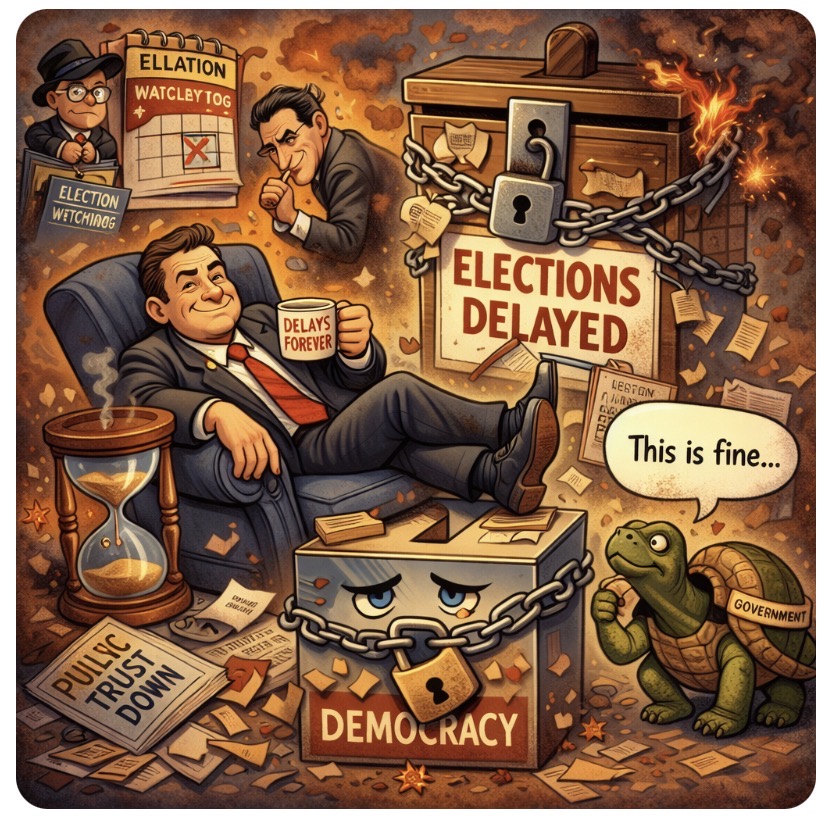
Election delays are “wrong,” says the watchdog. No good reason. No compelling excuse. No administrative fairy tale strong enough to justify shelving democracy for over a year.
And when the referee starts blowing the whistle, you know the game’s getting messy.
The head of the Electoral Commission has drawn a line: postponing votes for more than twelve months isn’t prudent governance — it’s democratic drift.
And drift, in politics, has a funny way of turning into design.
🏛️ Democracy Delayed… But For Whose Convenience?
Let’s not pretend election delays are paperwork hiccups. Elections are the oxygen of representative government.
Delay them long enough and the room gets stuffy.
Governments may frame postponements as practical. Strategic. Necessary. Sensible.
But here’s the uncomfortable question:
If democracy is strong, why does it need to be paused?
Emergencies happen. Crises exist. But when “temporary” stretches past a year, it stops feeling like a safeguard and starts feeling like insulation.
Insulation from accountability.
Insulation from public mood swings.
Insulation from losing.
And voters notice. They always notice.
The Electoral Commission’s warning isn’t theatrical outrage. It’s procedural alarm. A quiet but firm reminder that the calendar matters — because power without a clock is power without pressure.
And power without pressure tends to relax a little too comfortably. 🛋️
🔥 Challenges 🔥
If election delays become acceptable, where does it stop?
Is this genuine necessity — or political convenience dressed up as caution?
Head to the blog comments and tell us: should governments ever postpone democracy beyond a year? And if so — who decides when enough is enough?
👇 Comment. Like. Share.
The sharpest takes will be featured in the next issue of the magazine. 📰⚡


 Chameleon Magazine
Leave a comment