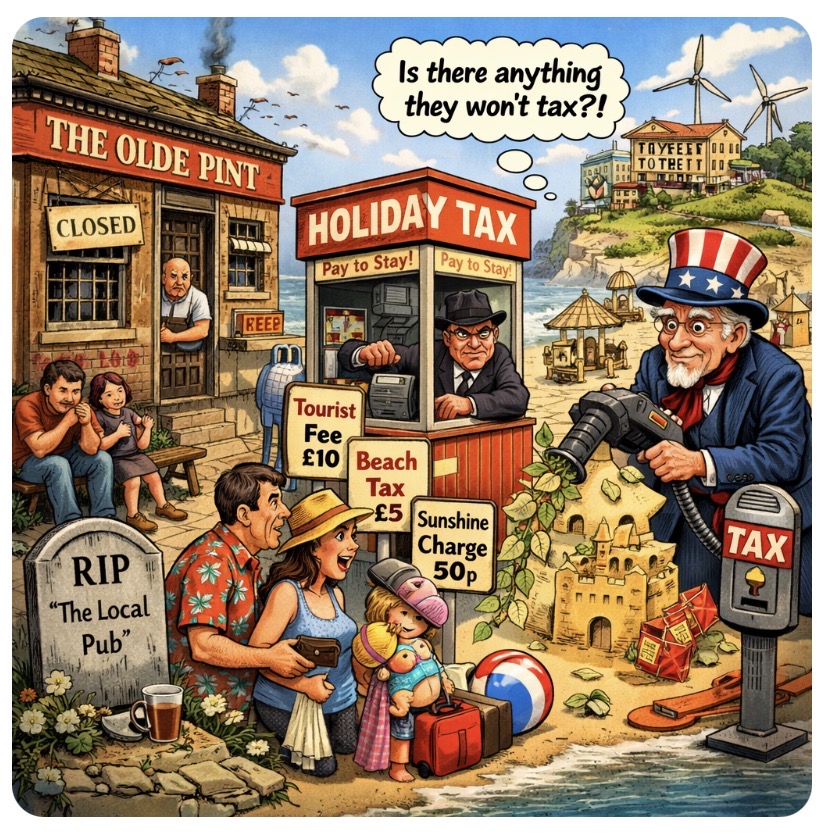
🍺🏖️💸First the pubs. Now the pillow mints.
We watched local watering holes fade into boarded-up nostalgia, blamed on rates, regulations, rising costs and the slow suffocation of small hospitality. Now, just as Brits cling to the humble staycation like it’s the last deckchair on Brighton Beach, along comes the whisper of a “visitor levy.”
Pay to park.
Pay to stay.
Pay to exist within municipal boundaries.
At this rate, breathing in a market town might require a contactless tap. 😏
🍻 From Last Orders to Ledger Books
There’s a growing feeling that the social glue of Britain — the pub, the seaside weekend, the spontaneous city break — is being quietly itemised.
The argument from government circles? Local leaders need tools. Infrastructure needs funding. Tourists use services. Why shouldn’t visitors chip in? It’s all very tidy on a Treasury spreadsheet. 📊
But critics see something else: the slow monetisation of normal life.
Your local high street already limps along under business rates and energy costs. Add a perception that visiting comes with a surcharge and suddenly that “quick weekend away” becomes “maybe we’ll just stay home.”
And when footfall drops, who feels it?
Not the policy paper.
Not the press release.
But the café owner. The B&B. The bar staff pulling the last decent pint in town. 🍺
Because here’s the tension:
Is it civic contribution…
Or civic creep?
When everything feels taxed — fuel, work, inheritance, holidays — the psychological effect matters as much as the financial one. People don’t just count pounds; they count principle.
And once voters start asking, “Is there anything they won’t tax?” — that’s not just economics. That’s erosion of trust. ⚖️
🔥 Challenges 🔥
Are we funding our towns — or pricing people out of them?
Has Britain over-regulated its own charm? Or is this just modern reality and necessary trade-offs?
Don’t just grumble into your pint. 🍺
Take it to the blog comments and tell us: where’s the line between fair contribution and fiscal overreach?
👇 Comment. Like. Share.
Tag someone who remembers when a weekend away didn’t require a spreadsheet.
The sharpest takes will be featured in the next issue of the magazine. 📰🔥


 Chameleon Magazine
Leave a comment