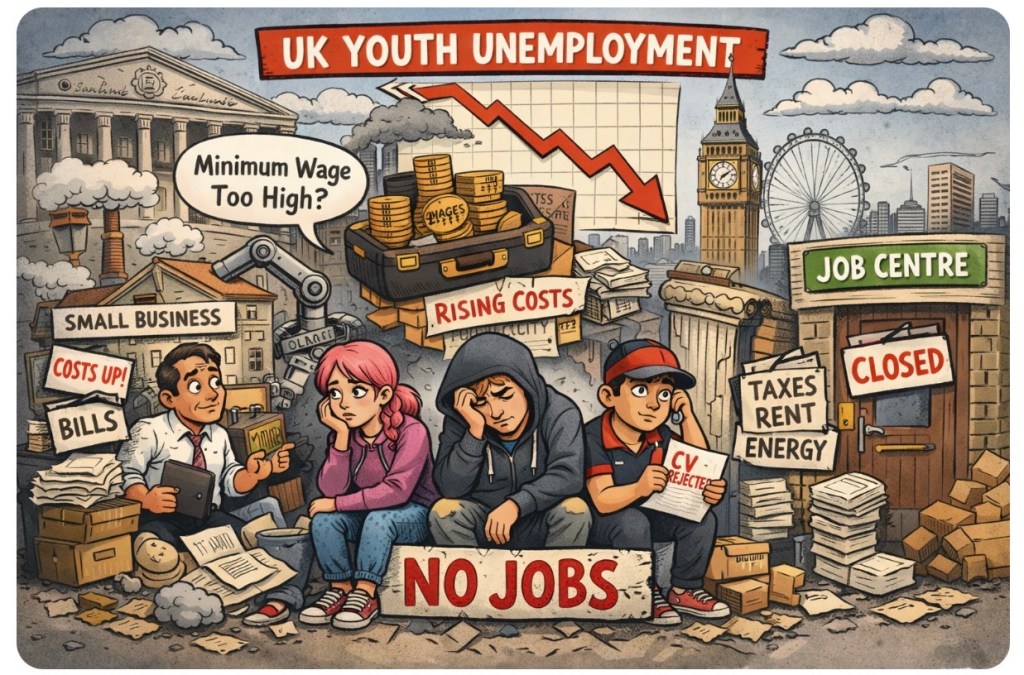
Britain finds itself topping a table no government wants framed on the wall — youth unemployment reportedly higher than anywhere else in Europe. No fireworks. No patriotic fanfare. Just a growing question mark hanging over a generation trying to enter the workforce.
So what are officials and economic commentators actually saying is behind it?
No spin. No counter-argument. Just their reasoning.
🏦 The Case Being Made by Policymakers
A senior voice at the Bank of England has suggested that rising minimum wage levels may be playing a role.
Here’s the logic being presented:
• Higher entry-level wage costs mean employers must pay more upfront for inexperienced workers.
• Young workers typically require training and supervision, meaning their immediate productivity can be lower than more experienced staff.
• When wage floors rise quickly, some businesses may reconsider hiring at all.
• Small and medium-sized enterprises, operating on tighter margins, may feel this pressure most acutely.
• Automation and restructuring become more attractive when labour costs increase.
The argument is arithmetic, not emotional: if the cost of hiring rises beyond what a business believes a new worker can produce in value, the role may simply not be created.
The concern being voiced is not ideological, but practical: when businesses face uncertainty and rising costs simultaneously, hiring becomes more cautious — and entry-level positions are often the first to be paused.
🔥 Challenges 🔥
Do these explanations reflect what you’re seeing on the ground?


 Chameleon Magazine
Leave a comment