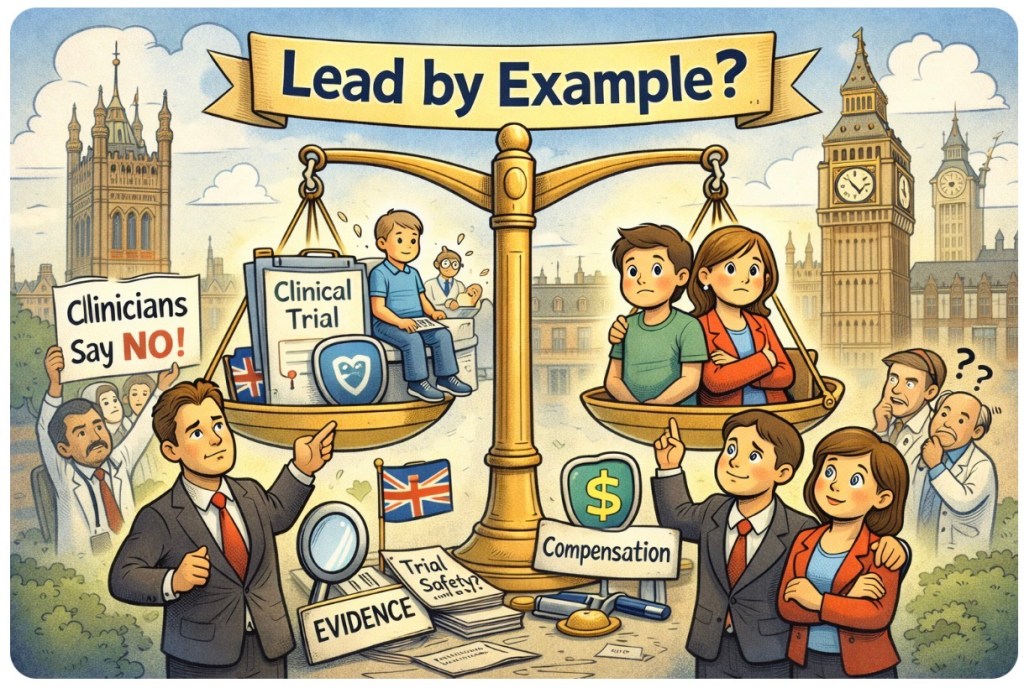
🏛️🧪When Parliament backs a controversial medical pathway despite open concern from sections of the clinical community, one argument erupts like clockwork:
If you believe it’s safe — prove it. Start with your own.
Not out of rage. Not out of spite. But out of principle. Accountability. Skin in the game.
Because nothing clarifies conviction like personal stake. 🎯
🏛️ Practice What You Legislate
Here’s the core challenge being raised:
If MPs are confident enough in the ethical safeguards, scientific rigour, and compensation structures surrounding a puberty blocker trial, why shouldn’t their own families be the first to demonstrate that confidence?
We ask military leaders to understand the cost of war.
We expect financial regulators not to gamble recklessly.
We frown upon politicians who exempt themselves from policies they impose.
So the argument goes: if this trial is genuinely robust — powered correctly, independently monitored, ethically consented, with long-term follow-up — then there should be no hesitation in applying it universally. Including to the children of those who endorse it.
It’s not about targeting children. It’s about moral symmetry. ⚖️
When clinicians voice concern.
When evidence is described as incomplete.
When long-term effects remain uncertain.
Public trust depends on leaders demonstrating they are not insulated from consequence.
And that’s the tension.
Because here’s the ethical counterweight:
Clinical trials cannot be political theatre. Participants cannot be selected based on symbolism, status, or political messaging. Research ethics demand voluntary participation free from coercion — and the children of public officials sit in a uniquely pressured position.
So the “start with your own” argument lands emotionally… but clashes technically with research ethics.
Still — the public question lingers:
If the safeguards are strong, why does symbolic reciprocity feel so uncomfortable? 🤔
🔥 Challenges 🔥
Is this about fairness — or about frustration with power?
Should lawmakers face a higher moral threshold when endorsing risk in paediatric medicine?
Would public trust increase if politicians lived under the exact same exposure to uncertainty as everyone else?
Or does turning children into political proof-points undermine the very ethics we claim to defend?
Don’t just debate this on social media. Bring the nuance. Bring the conviction. Bring the counter-argument. 💬🔥
👇 Comment on the blog. Like. Share. Challenge the premise.
The sharpest, smartest responses will be featured in the next issue of the magazine. 📰✨


 Chameleon Magazine
Leave a comment