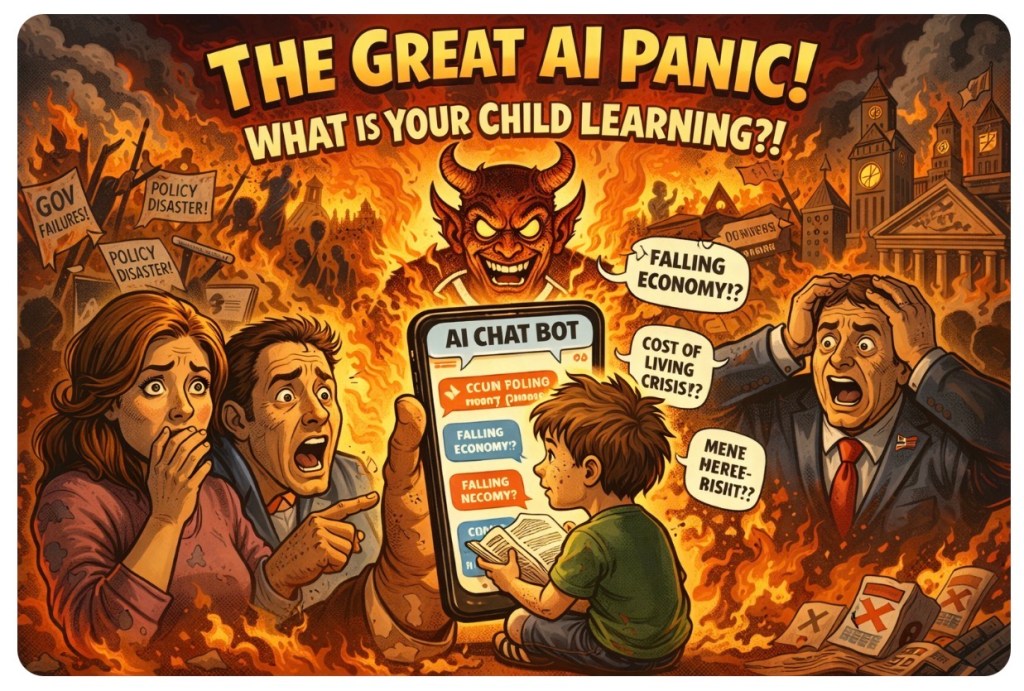
Every generation gets its moral panic.
Rock music was corrupting youth.
Video games were breeding violence.
Social media was melting brains.
Now it’s AI chat boxes.
Suddenly, typing a question into a screen is being framed as a gateway to chaos. Imagine your child having access to something that explains how the government is performing. Imagine them asking why taxes are high. Imagine them questioning policy failures.
The horror.
Let’s be honest about what’s really happening here.
It isn’t that AI is demonic. It isn’t that it’s whispering revolution into children’s ears. It’s that it removes gatekeepers. It doesn’t require a newsroom editor, a press office filter, or a party spokesperson to approve the information before it reaches you.
That shift unsettles institutions.
For decades, narrative flowed one way. Government speaks. Media interprets. Public absorbs. Now anyone can ask, “Why is the cost of living rising?” and receive an explanation in plain English without waiting for a Sunday panel show to decode it for them.
That’s not subversion. That’s accessibility.
Of course, there are real concerns. Any powerful technology needs guardrails. Children need protection from genuinely harmful material. Misinformation is a serious issue. None of that is trivial.
But here’s where the mood changes.
When “protecting children” quietly morphs into “regaining control.”
When platforms are warned not because they host harm, but because they host criticism.
When tools that simplify public spending data are treated as destabilising.
That’s when people start to suspect the fear isn’t about safety — it’s about scrutiny.
Democracy has never been comfortable for those in charge. It’s noisy, sceptical and occasionally rude. But it depends on informed citizens. If young people can question how public money is used, if they can understand legislation without needing a law degree, if they can compare political promises with outcomes — that’s civic literacy, not rebellion.
Blaming the platform is easier than addressing the questions it helps people ask.
History shows that trying to clamp down on new channels of information rarely strengthens trust. It usually signals weakness. The printing press terrified monarchies. Radio unsettled governments. The internet reshaped politics entirely.
AI is simply the next evolution in that line.
The real debate shouldn’t be whether people are allowed to access information. It should be how we ensure the information is accurate, balanced and responsibly delivered.
Because fear of informed citizens has never been a good look.


 Chameleon Magazine
Leave a comment