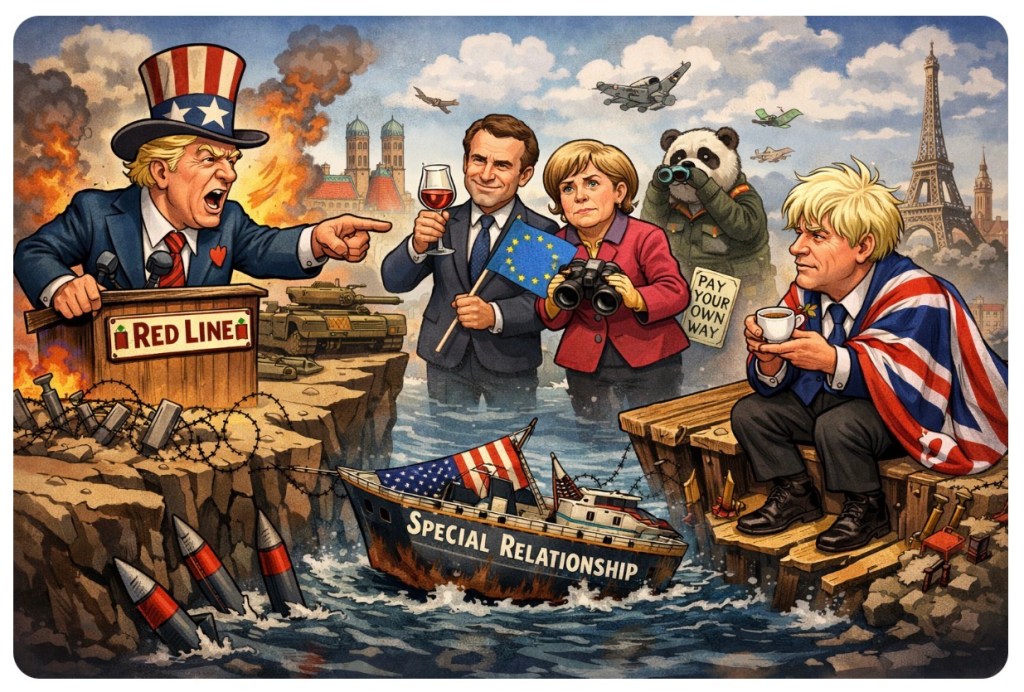
🇺🇸🇪🇺🎙️A fiery U.S. Republican foreign policy speech in Munich has reignited the age-old question: is Europe finally packing its own geopolitical lunchbox? With talk of “red lines” and shifting priorities, the transatlantic alliance suddenly feels less like a rock-solid marriage and more like a passive-aggressive WhatsApp chat. Meanwhile, the UK is hovering awkwardly at the door—Brexit papers in one hand, EU flirtation in the other. 🍿
🧨 Red Lines, Red Faces & The Sound of Europe Clearing Its Throat
When American politicians start drawing “red lines” in European sand, it tends to echo loudly in places like Munich—especially during high-profile security gatherings like the Munich Security Conference. The subtext? “Europe, you might want to start lifting more than just canapés at NATO summits.” 🥂
For decades, the backbone of Western security has been NATO—with the United States playing quarterback, coach, and occasionally exasperated parent. But between strategic fatigue, domestic political theatre, and an ever-assertive China, whispers of American retrenchment are growing louder.
And Europe? Well, after watching Washington’s mood swings over the last decade, some leaders are quietly wondering if “strategic autonomy” is less a French daydream and more a survival plan. Enter Emmanuel Macron, stage left, waving the EU flag and muttering, “I did try to tell you.” 🇫🇷
The real question isn’t whether Europe can fend for itself. It’s whether it wants to pay the bill. Defence spending hikes are popular in theory—right up until someone suggests cutting pensions to fund tanks. 🚜➡️🛡️
And then there’s the UK. Ah yes, the geopolitical middle child. Post-European Union divorce, United Kingdom has insisted its “special relationship” with the U.S. is stronger than ever. But if Washington starts looking inward and Brussels starts building muscle, London may find itself rediscovering continental charm faster than you can say “customs union.” 🇬🇧💔🇪🇺
Will America regret nudging Europe toward independence? Possibly. Strategic autonomy can morph into strategic stubbornness. A Europe that spends more on defence may also demand more say—less junior partner, more equal shareholder.
But let’s not kid ourselves. The Atlantic isn’t shrinking. Shared intelligence, integrated command structures, and decades of military interoperability don’t vanish because of one speech. The alliance has survived Suez, Iraq, Afghanistan, and more summits than anyone cares to remember. 🌊
Still, something has shifted. The polite assumption that Uncle Sam will always pick up the tab is fraying. And Europe is eyeing the receipt. 🧾
🔥 Challenges 🔥
Is this the moment Europe finally grows strategic teeth—or just another round of summit theatrics? Will the U.S. wake up to a more independent Europe and think, “Well… that escalated”? Or is this long overdue tough love?
Don’t shout into the social media void—drop your sharpest take in the blog comments. Stir the pot. Challenge the narrative. Tell us who blinked first. 💬🔥
👇 Comment. Like. Share. Drag a diplomat (metaphorically).
The boldest, sharpest responses will be featured in the next issue of the magazine. 📰✨


 Chameleon Magazine
Leave a comment