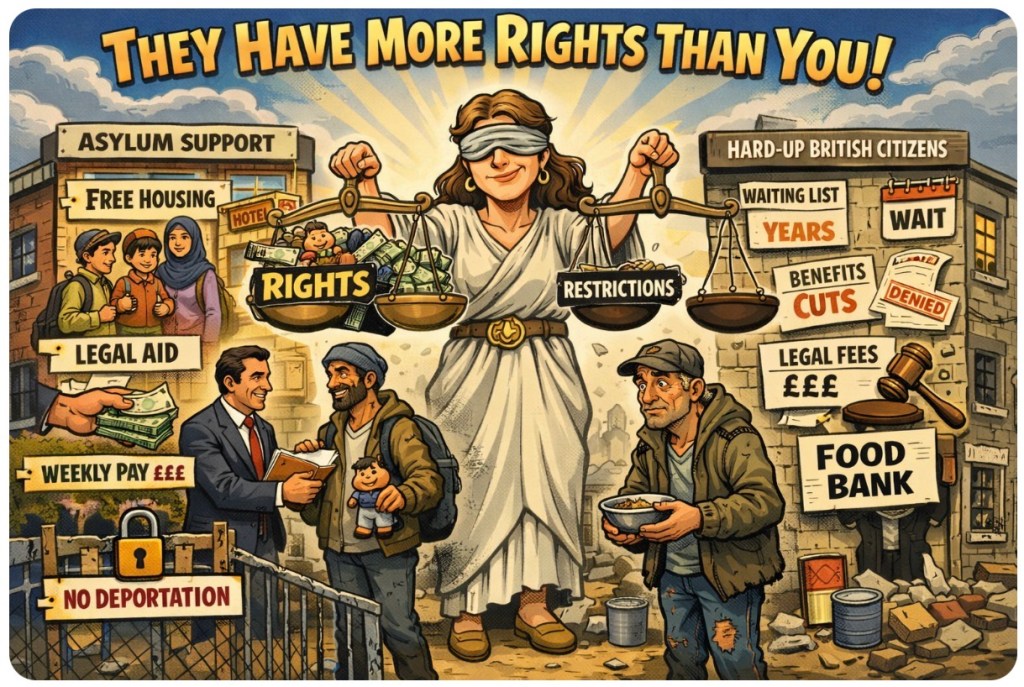
There’s a question being muttered in kitchens, job sites, taxis and pub gardens across the country:
How do the rights of someone arriving illegally compare to the rights of someone who’s lived and worked here their whole life?
Because on the surface, it can feel like two completely different rulebooks.
😤 The Outrage Fuel
Here’s what many working people see:
Someone crosses the Channel illegally.
They claim asylum.
They receive:
- Accommodation
- Subsistence support
- Legal aid
- Protection from immediate removal
- Human rights safeguards
- Access to appeal processes
Meanwhile, a British citizen who falls on hard times faces:
- Strict benefit eligibility rules
- Sanctions for missed appointments
- Long housing waiting lists
- Bureaucratic hoops for disability claims
- Limited legal aid
That contrast hits emotionally. Hard.
It feels like:
“You break the rules to get in, and the system cushions you.
You follow the rules all your life, and the system questions you.”
🔥 That’s the perception driving the anger.
⚖️ The Legal Reality (Less Dramatic, Still Complicated)
In law, the reason is this:
Asylum seekers are protected under international refugee law once they claim protection.
British citizens already have full civil and political rights — but welfare entitlements operate under different legislation with stricter conditionality.
So it’s not that migrants have “more rights.”
It’s that they have different rights triggered by a specific legal status.
That distinction rarely makes headlines.
🏚️ Where the Comparison Gets Raw
Let’s compare practically:
🏠 Housing
- Asylum seekers: Provided accommodation (often basic, sometimes hotel-based, no choice of location).
- British citizens: Must apply via councils, often years on waiting lists.
💷 Financial Support
- Asylum seekers: Around £45 per week in support (restricted use).
- British citizens: Universal Credit, but subject to work requirements and sanctions.
⚖️ Legal Support
- Asylum seekers: Access to legal aid for asylum claims.
- British citizens: Legal aid is now limited in many civil areas (housing, family, etc.).
This is where resentment builds.
Not because asylum support is luxurious — it isn’t.
But because British citizens often feel their own support system has been stripped back over time.
So when they see legal protections being enforced for newcomers, they ask:
“Why was ours tightened, but theirs defended?”
🎭 The Political Mismatch
Governments promise tough borders.
Courts enforce human rights law.
Welfare policy for citizens gets progressively stricter.
The result?
Two systems that look wildly inconsistent — even if legally they’re built on different foundations.
And when something looks inconsistent, people assume unfairness.
🔥 The Real Underlying Issue
The anger isn’t always about migrants.
It’s about:
- Shrinking public services
- Rising taxes
- Reduced safety nets
- And a sense that the social contract has frayed
If citizens felt secure, supported, and fairly treated, the comparison wouldn’t sting as much.
But when life feels harder for those who “played by the rules,” any perceived imbalance becomes explosive.
🔥 Challenges 🔥
Do you believe the system treats long-term citizens fairly compared to new arrivals?
Should welfare rules be rebalanced — and if so, how?
Is the problem migrant rights — or the erosion of support for everyone else?
Drop your thoughts in the blog comments — not just heat, but honesty. 💬🔥
👇 Comment. Like. Share. Let’s compare the rulebooks properly.
The strongest responses will be featured in the next issue of the magazine. 📝


 Chameleon Magazine
Leave a comment