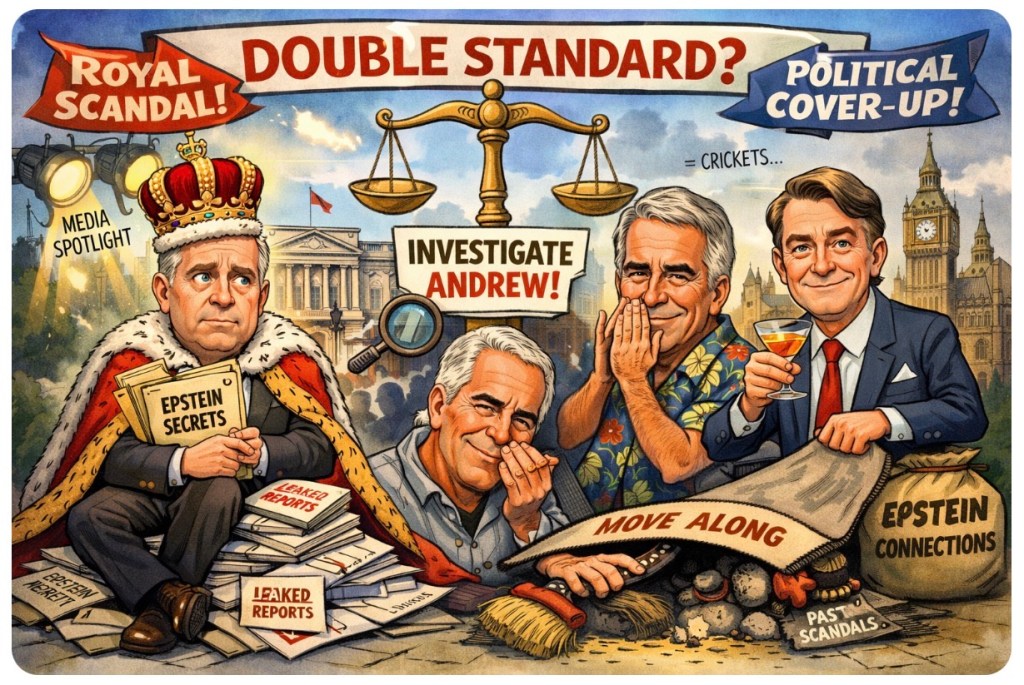
When a former minister calls for Andrew to be investigated over alleged misconduct during his time as UK trade envoy—specifically accusations of leaking confidential reports to Jeffrey Epstein—the headlines practically write themselves. Royal drama? Tick. Elite misconduct? Tick. Public outrage? Always in stock.
But as fingers point in one gilded direction, a familiar question bubbles up: are we applying justice evenly—or just theatrically? 🎭
🎩 The Curious Case of Convenient Outrage
Let’s start with Prince Andrew—once Britain’s globe-trotting trade envoy, now permanently associated with uncomfortable interviews and even more uncomfortable friendships. The allegation? That while serving in an official capacity, confidential trade information may have been shared with the late Jeffrey Epstein. If proven, that’s not just poor judgment—it’s potentially misconduct in public office. A serious charge, not tabloid confetti.
Naturally, the call for investigation grows louder. Transparency! Accountability! Consequences! 🧾⚖️
But then comes the counter-whisper: what about Peter Mandelson?
Ah yes—Lord Mandelson. A man whose political career has had more comebacks than a 90s boy band. Former Business Secretary. Twice resigned. Later resurrected. Close ties to—you guessed it—Epstein as well. Yet the volume knob on that chapter of history sometimes feels… muted. 🎚️
Now here’s where it gets deliciously awkward.
If the standard is “any public official with inappropriate links to Epstein or questionable conduct should be investigated,” then that standard shouldn’t wobble depending on title, party, or postcode. Accountability cannot be à la carte. You don’t get to order justice medium-rare for one and well-done for another. 🥩
But politics, dear reader, loves selective memory. Royal scandal? Front page. Party grandee entanglements? Often buried under procedural jargon and strategic shrugs.
Is that fair? Is it proportional? Or is it simply the way power protects itself—wearing different coloured ties?
Let’s be clear: allegations are not convictions. Investigations are not verdicts. But consistency matters. If public trust is to mean anything at all, it cannot depend on whether the accused wears ermine or a red rosette.
And that’s the real story here. Not just who might have done what—but who we decide deserves scrutiny. 👀
🔥 Challenges 🔥
If justice is blind, why does it sometimes peek through one eye?
Are we demanding accountability across the board—or just when it’s politically convenient?
Drop your thoughts directly in the blog comments (not just social media sidelines). Stir the pot. Bring the receipts. Ask the uncomfortable questions. 💬🔥
👇 Comment. Like. Share. Call out the double standards wherever you see them.
The sharpest takes will be featured in the next issue of the magazine. 📝✨


 Chameleon Magazine
Leave a comment