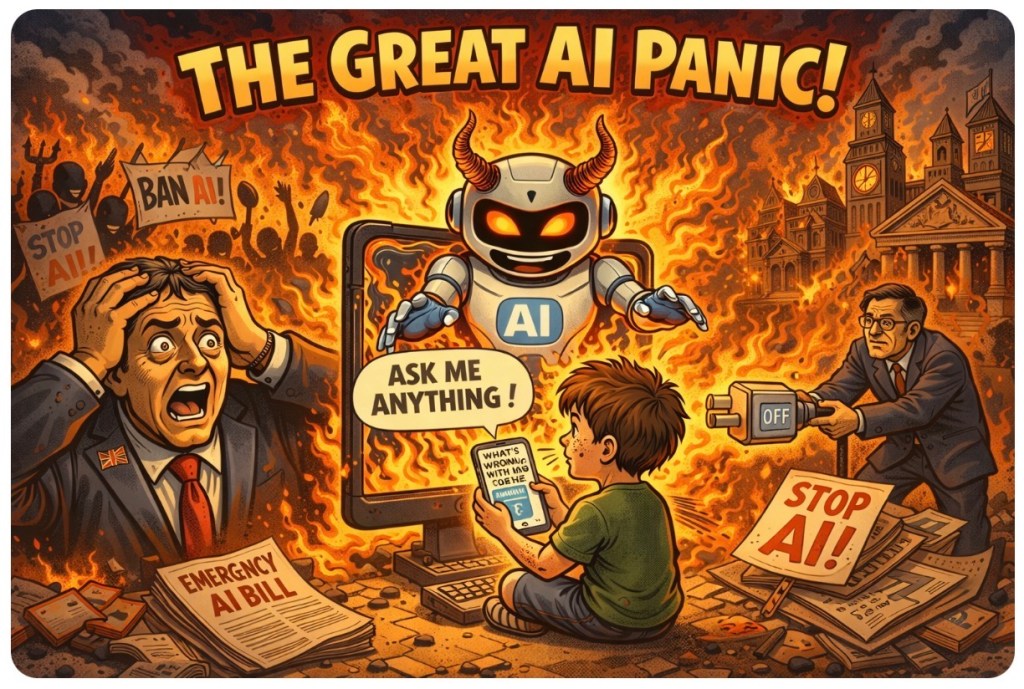
While China builds, India scales, America experiments and Europe regulates without unplugging the future… Britain is hovering over the Wi-Fi router like a nervous parent at 2am.
“Should we just switch it off?” 😱
Because apparently, the real threat to civilisation isn’t inflation, stagnation or policy U-turns. It’s a teenager asking an AI why the government can’t balance a spreadsheet.
🧠 Ban the Tool, Save the Narrative!
Picture the scene.
A 14-year-old types:
“Why is the cost of living rising?”
The AI calmly explains supply shocks, fiscal policy, energy markets and productivity gaps.
Somewhere in Whitehall, a teacup rattles.
This is how it starts, they whisper. First it’s homework help. Next it’s… questions.
Heaven forbid a generation raised on smartphones develops the ability to interrogate public spending in plain English.
For decades the information chain was simple. Government speaks. Media filters. Public absorbs. Now a child can ask direct questions and receive structured answers without waiting for a panel show to argue about it.
That’s not rebellion. That’s decentralisation. And decentralisation makes control harder.
🎓 Protect the Children… From Knowledge?
Of course children need safeguarding. No sane person argues against age-appropriate controls or digital literacy.
But there’s a world of difference between guardrails and handcuffs.
Are we really going to tie our kids’ hands behind their backs while the rest of the world hands theirs power tools?
Because here’s the uncomfortable global context:
China isn’t banning AI education.
India isn’t pausing its tech workforce.
The US isn’t shutting down innovation hubs.
Europe isn’t unplugging its research labs.
They’re competing.
If Britain’s grand strategy becomes “slow down so nobody gets uncomfortable,” we won’t be morally superior — we’ll be technologically behind.
And falling behind in AI doesn’t just mean fewer clever apps. It means:
Weaker productivity.
Reduced competitiveness.
Lower influence.
Fewer high-value jobs.
But at least the narrative will be tidy.
🪜 The Intelligence Ladder
You don’t climb the intelligence ladder by banning ladders.
You climb it by teaching people how to use them without falling off.
AI is not a Ouija board. It’s a tool. A powerful one. One that can educate, accelerate, and democratise access to information.
The real fear isn’t that children will learn too much.
It’s that they’ll learn to question confidently.
And questioning is awkward for institutions that prefer applause.
🔥 The Control Reflex
Governments don’t normally move because a handful of parents are anxious. They move when influence shifts. When gatekeeping weakens. When the narrative escapes its enclosure.
When they can’t steer the conversation, the temptation isn’t always to improve performance.
Sometimes it’s to restrict the microphone.
But here’s the twist: the more you try to clamp down on emerging technology, the more you signal insecurity.
Strong nations adapt.
Weak leadership panics.
Which one are we aiming to be?
🔥 Challenges 🔥
Are we protecting children — or protecting fragile narratives?
Should Britain lead in AI literacy, or retreat in fear of uncomfortable questions?
Would restricting access make us safer — or simply slower?
Drop your take in the blog comments — not just outrage, but foresight. 💬🔥
👇 Comment. Like. Share. Let’s decide whether we’re building the future or hiding from it.
The sharpest comments will be featured in the next issue of the magazine. 📝


 Chameleon Magazine
Leave a comment